

They Told You Nigeria’s Banks Moved Their Money Into Farming. The Table Says They Moved It Into Land.
“Banks shift credit to agriculture.”
That headline ran on 3 Nigerian outlets last weekend, all of them reading the same table.
The table is the Central Bank of Nigeria’s Quarterly Statistical Bulletin for the first quarter of 2026. Agriculture did gain. It gained N150 billion.
Real estate gained N1.62 trillion.
Read the table, not the headline
Between January and March 2026, Nigerian bank credit to real estate went from N4.67 trillion to N6.29 trillion. Manufacturing went the other way, from N6.57 trillion to N5.77 trillion, a fall of N800 billion in 90 days. Oil and gas shed N335 billion. Power and energy added N310 billion.
Agriculture’s N150 billion, the figure that made every headline, was the smallest gain of any sector that gained at all.
Total sectoral private credit did not shrink. It rose, from N57.41 trillion to N59.74 trillion.
The banks did not stop lending.
They changed what they were willing to lend against.
The forbearance ended and the definition of safety narrowed.
2025 is when the bill arrived. As the Central Bank unwound its Covid-era forbearance, loans that had been performing on paper migrated into the impaired column, and 5 banks alone, Access, UBA, Ecobank, First HoldCo and FCMB, booked N2.16 trillion of impairments between them.
The clearest single case is still running. Nestoil owes $1.084 billion and N469.43 billion to a consortium of 8 lenders, has repaid $60 million under a receivership brokered by the Economic and Financial Crimes Commission, and has $40 million due in the next tranche.
A bank that has just written down that much does not go looking for a better borrower.
It goes looking for a better asset to seize.
The manufacturer is standing between 2 pools of money that want opposite things.
While the banks were moving N1.62 trillion into property, Nigeria’s pension funds were sitting on N31.48 trillion and holding under 1% of it in real estate, on governance concerns.
The banks are buying property because it can be repossessed. The pension funds are refusing property because it cannot be verified.
Both are behaving rationally. The manufacturer between them gets nothing.
Foreign money is not covering the difference either. Nigeria’s foreign direct investment fell to $135.08 million in the first quarter of 2026 from $357.80 million, which is 1.3% of the $10.37 billion of total capital that came in.
This is not a credit shortage, and it did not start this quarter. Manufacturing credit was N8.53 trillion in December 2024, N6.61 trillion in December 2025, and N5.77 trillion by March 2026.
It is a collateral preference, and it has been hardening for over a year.
The question a Nigerian bank asks a manufacturer is not whether the business earns. It is whether there is land behind it.
Who wins, who is squeezed, and the gap
Who wins is anyone holding titled property, and the developers now absorbing N1.62 trillion of fresh bank exposure at a 27% policy rate.
Who is squeezed is the manufacturer, the processor, the packager and the logistics operator. Every business whose value sits in machines, inventory and receivables rather than in a deed.
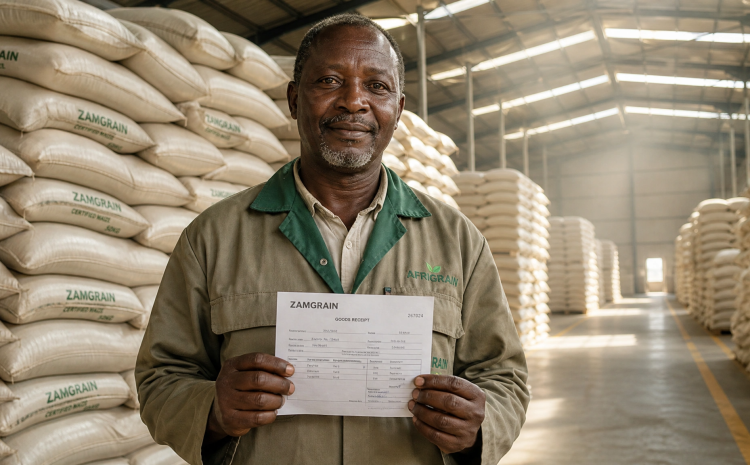
The gap is the part that makes this a build rather than a complaint. Nigeria has had a National Collateral Registry since 2016 and the Secured Transactions in Movable Assets Act since 2017. Both exist for precisely this purpose: to let a business borrow against inventory, equipment and receivables instead of land.
The law is 9 years old. Manufacturing credit still fell N800 billion in a quarter.
The instrument exist but the market does not.
That market is 3 businesses, and none of them requires a banking license. Receivables and purchase-order finance, which turns a signed order from a creditworthy buyer into working capital today. Inventory and warehouse-receipt finance, which needs independent operators who can certify what is on the warehouse floor and what it is worth. And underneath both, the perfection layer: registry filing, priority searches and enforcement, the unglamorous work that makes a lender believe a claim will actually hold.
Nigeria wrote the law and never built the industry that uses it.
At the Business Week Afrika Summit on 1 and 2 October 2026, the room holds both halves of this problem. The lenders deciding what counts as security are there, and so are the operators whose assets move on wheels and pallets instead of sitting under a title deed. The conversation that needs to get started is not about interest rates. It is about what an African bank is willing to call collateral, and who is going to do the verification work that makes the answer wider.
Secure your seat and join the builders working out what Africa lends against next: https://apps.little.africa/events/105
Somewhere outside Lagos, Nigeria there is a factory owner with confirmed orders on her desk, a warehouse of finished goods behind her, machines that run 6 days a week, and a bank relationship older than the loan she is asking for.
She will be asked for a title deed.
The goods are the collateral. Somebody has to be willing to lend against them on a Monday.