

$3.2 Billion and a Stablecoin Strategy: Why Ripple Paid to Sit Inside Africa’s Money Rails
A week ago the story was that stablecoins had stopped being a threat and become infrastructure. This week the infrastructure got a price tag and a strategic owner.
Read together, the two moves describe the same shift one step further along:
The layer where Africa’s money moves is no longer just being built, it is being bought.
The deal
Ripple took a strategic stake in Flutterwave’s Series E round, valuing the company at $3.2 billion and confirming its standing as Africa’s most valuable startup. The money is not the headline. The integration is.
Flutterwave is wiring Ripple’s RLUSD stablecoin, Ripple Payments, and the XRP Ledger directly into a network that has already processed over 1 billion transactions and more than $50 billion in payment volume, serving names from Uber and Air Peace to PiggyVest and Bamboo.
CEO Olugbenga Agboola was precise about what this is:
“Our stablecoin infrastructure is now live commercially and being tested across Send App.”
And on the partnership:
“Together, RLUSD, Ripple Payments, and the XRP Ledger strengthen the foundation we’ve already built and accelerate the next phase of our stablecoin strategy.”
Olugbenga Agboola
Strip the language down. The most valuable company on the continent has decided its next decade runs on stablecoin rails, and one of the world’s largest crypto-infrastructure firms has paid to sit inside that decision. The compliant layer where fiat meets stablecoin, the one we flagged last week as the prize, now has a flagship occupant and a foreign balance sheet behind it.
Why an equity stake changes the game
Capital chooses.
When Ripple writes a strategic cheque rather than a commercial contract, it is not buying a customer, it is buying a position in how an entire region will settle value. That validation pulls the rest of the market behind it:
The corridor model Flutterwave is proving, dollars in, RLUSD across, local currency out, becomes the template every other operator now has to match or undercut.
This is the same pattern that has run through African fintech for a decade, only inverted.
For years global capital priced African payments at 8% because correspondent banks were the only road. Now global capital is paying to own the road that routes around them. The middlemen who taxed every cross-border transaction are not being regulated out, they are being capitalised out.
The bill the IMF just sent
Then, in the same news cycle, the counterweight.
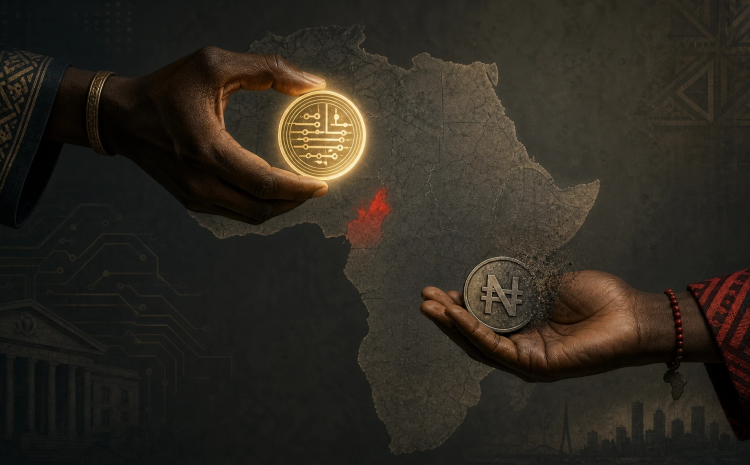
The IMF warned that dollar-denominated stablecoins could undermine demand for the naira.
This is the price of the rebuild stated plainly.
Every RLUSD or USDC corridor that makes a cross-border payment cheaper also makes the local currency a little less necessary. With roughly 40% of Nigerians already using crypto for international transfers, the question for central banks is no longer adoption, it is sovereignty:
Who issues the unit that the new rails carry?
That tension is not a problem to be solved away. It is the single biggest opening on the board.
The signal for builders
Who wins?
The infrastructure around the giant.
Flutterwave plus Ripple will own the headline corridors, but a $3.2 billion company cannot service every market, every compliance regime, or every fattest-spread niche.
The builders who win are the ones supplying the picks and shovels: licensed on and off ramps in markets Flutterwave deprioritises, treasury tools that let a business hold and settle across naira, cedis, shillings, and RLUSD, and corridor-specific products where the FX spread is widest.
Who gets displaced?
Neutral domestic processors that assumed they could stay Switzerland, and any fintech still treating stablecoins as a feature rather than a settlement layer.
And the sharpest gap of all, the one the IMF just lit up:
Local-currency stablecoins.
If a dollar stablecoin riding African rails threatens the naira, the answer a builder can start on Monday is a compliant, naira- or shilling-denominated stablecoin that keeps the settlement speed without exporting the monetary base. The sovereignty fight is a product brief. Whoever writes the African unit for these rails owns a position no foreign cheque can buy.
The rails are no longer the opportunity. Owning what runs on them is.
The founders building Africa’s settlement layer, the global capital now buying into it, and the regulators deciding whose currency it carries are setting the terms of the continent’s financial decade. The Business Week Afrika Summit on 1st and 2nd October 2026 puts all three in the same room. Secure your seat.
#TwendeBWA