

The Dollar Sanctuary: Two Rivers Triggers Sh3.9 Billion Listing to Fight Macro Contraction
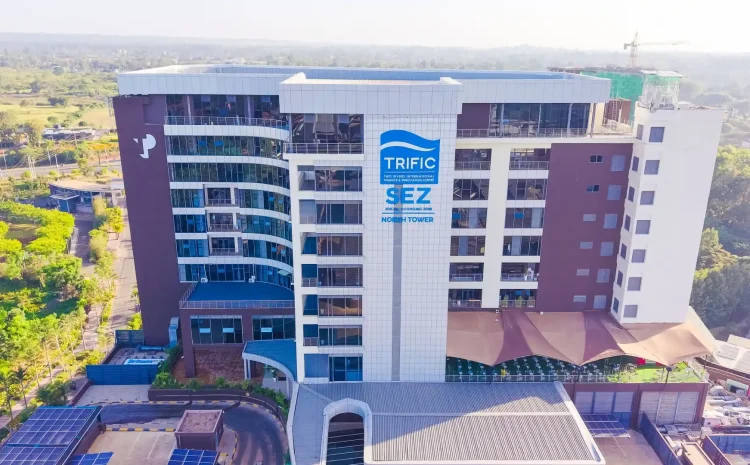
Nairobi’s capital markets are witnessing a major structural milestone today, May 28, 2026. The Two Rivers International Finance & Innovation Centre (TRIFIC) has officially launched a public offer to raise nearly $30 million (Sh3.88 billion) through a pioneering, dollar-denominated property investment fund.
Known as the TRIFIC Green USD Income Real Estate Investment Trust (I-REIT), the fund is scheduled to debut on the Nairobi Securities Exchange (NSE) by the end of June. This move provides local and international investors with an aggressive hedge against domestic currency fluctuations, high inflation, and a contracting private sector.
1. Bypassing the Shilling: The 8% Dollar Promise
Backed by the ultra-modern North Tower building located within Nairobi’s Special Economic Zone (SEZ), this unique investment vehicle is engineered for stability.
- The Dollar Hook: Unlike traditional local listings, this I-REIT operates entirely in US Dollars. It offers an 8% dividend yield payable twice a year, effectively shielding investor capital from local currency drops.
- Lowering the Barrier: The minimum entry point has been fixed at $1,000 (approx. Sh129,000). This allows retail investors to park their savings alongside major pension funds and insurance firms before the public offer closes on June 12.
- The Scale-Up: Highlighting real estate demand within the SEZ corridor, TRIFIC has already initiated groundwork for a second office block valued at $20 million (Sh2.6 billion).
2. The Activist Rebellion: Demand for a Sh129 Billion “Wealth Tax”
While institutional capital moves toward dollar-denominated shelters, a massive political battle is exploding in Parliament today. A powerful coalition including the Institute of Public Finance (IPF), Oxfam Kenya, and the Kenya Human Rights Commission (KHRC) has formally petitioned lawmakers to completely overhaul the Finance Bill 2026.
- The Core Argument: Activists insist that relying heavily on consumption taxes like VAT and PAYE unfairly burdens low-income households.
- The Proposal: The coalition is demanding the state abandon aggressive indirect levies and instead target Kenya’s 7,200 dollar millionaires and 16 centi-millionaires. They argue a targeted wealth tax on luxury assets, high-value properties, and capital gains could generate Sh129 billion ($1 billion) to fund healthcare and education.
- Closing Loopholes: The civil society group also actively criticized proposed tax exemptions in privileged sectors like aviation, warning that the current code favors ultra-high-net-worth individuals over ordinary consumers.
3. The Corporate Backdrop: Margin Squeezes and Contraction
The rush for alternative financial products makes sense given the wider macroeconomic landscape.
- Private Sector Slump: The latest Stanbic Bank Purchasing Managers’ Index (PMI) highlights that private sector activity has contracted. This drop is driven heavily by transport and energy shocks passing through to consumer demand.
- Banking Realities: Proving that the high-cost environment is hitting top-tier firms, Standard Chartered Bank Kenya just reported a 26.3% drop in Q1 net profit, hitting its lowest first-quarter earnings run since 2021 due to compressed net interest margins.