

Africa Builds 5.5% of the World’s Data Centres. It Still Rents 99% of the Capacity
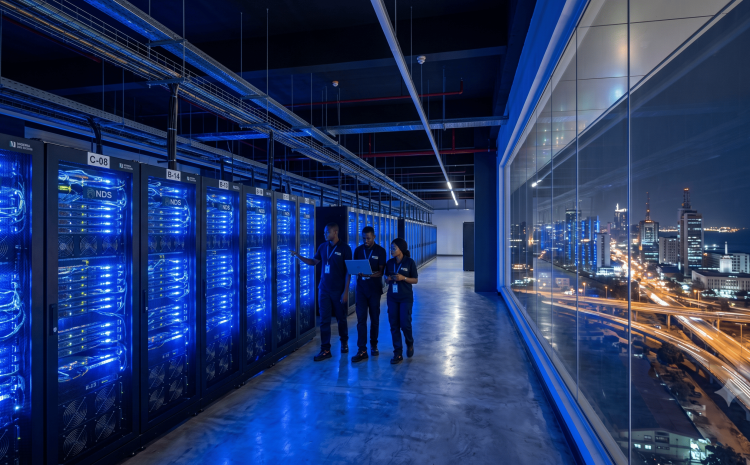
Every transaction a Nigerian bank processes tonight will sleep in a room it does not own, in a country it is not in.
That absence costs Nigeria 850 million dollars a year. Not in fraud, not in fees anyone can point to on a statement, just in the quiet decision to host banks, telcos, fintechs and government systems on servers sitting in Europe and North America instead of at home.
Widen the lens and the number gets stranger. Africa holds under 1% of the world’s data centre capacity. Roughly 80% of the continent’s own internet traffic is served from outside it. The data is African. The room it sleeps in is not.
The room finally has an owner
In March, Kenya switched on Servernah Cloud, built by Atlancis Technologies and EverseTech inside iXAfrica‘s 22.5 megawatt Nairobi facility and pitched as the continent’s first sovereign hosted AI and cloud platform. In May, Lagos commissioned Kasi Cloud, a 4 hectare campus in Lekki scaling to 100 megawatts, backed by Nigeria’s Sovereign Investment Authority and wired directly into six subsea cables including Equiano and 2Africa.
“Africa’s data has powered someone else’s economy. Today, that changes.”
Johnson Agogbua, Founder and CEO, Kasi Cloud.
MTN has committed over 240 million dollars to its own 9 megawatt Lagos facility. Equinix is putting 22 million dollars into a Lagos site of its own, part of a 100 million dollar, 2 year Africa plan. Open Access Data Centres has approved a 240 million dollar expansion to 24 megawatts by 2027. Nigeria’s data centre market, worth 288 million dollars in 2025, is projected to cross 1 billion dollars by 2031. The wider continental pipeline sits at 8.76 billion dollars by the same year.
“We cannot build an AI economy on foreign soil. The infrastructure must be here.”
Joe Mucheru, former Cabinet Secretary for ICT and the Digital Economy, Kenya.
This is the same pattern already reshaping a manganese mine in Gabon and a gold hub in Uganda. Stop shipping the raw thing out, keep the value where the raw thing was made. Here the raw thing is data.
Small rooms, not empty rooms
Africa is not actually absent from this map. The continent holds close to 5.5% of the world’s data centres by count. It still holds under 1% of the world’s capacity. Read both numbers together and the real gap appears: Africa builds rooms, just small ones, sized to what a market can pay for rather than what an AI workload needs.
Owning the room is not the same as keeping the lights on.
Kenya’s own answer to that gap almost became a cautionary tale instead of a case study. A proposed 1 billion dollar Microsoft and G42 data centre, envisioned to eventually draw a gigawatt, roughly a third of the country’s entire installed capacity, ran into a ceiling Nairobi could not raise fast enough.
“To switch on that one data centre, we would need to shut off power for half the country. That’s when I knew there was a problem.”
President William Ruto.
The IMF’s own numbers, out this week, put a figure on exactly that ceiling. Sub Saharan Africa’s AI dividend swings between 0.2% and 4% of GDP over the next decade on one condition: whether electricity, connectivity and skills get built alongside the servers.
Roughly half the region still lacks reliable power. Only 38% of Africans were online in 2024, against 68% worldwide.
Who builds where the room actually works: the sovereign cloud operators sizing a facility to the grid it sits on rather than to a headline number, the power behind the meter developers who can pair a data hall with its own generation instead of waiting on the national grid, the compliance and localisation specialists who turn a data protection law into a reason a bank finally moves its workload home.
Who gets squeezed: any operator still selling Africa a hyperscale number the continent’s grid cannot carry, and the foreign providers who have collected that 850 million dollars a year without ever having to justify it to a regulator.
Closing that gap takes an operator who understands a megawatt as well as a server rack, an energy financier willing to build the power first, and a regulator drawing the line between the two. The Business Week Afrika Summit on October 1 and 2 exists to put all three in the same room.
Secure your seat and join the builders deciding where Africa’s data finally sleeps: https://apps.little.africa/events/105
The rent is being cancelled. The room is finally Africa’s own. Will you be the one who keeps the lights on in it, or the one who rents that out too.