

Africa Perfected The Battery Swap On 2 Wheels. Now It Is Coming For 4.
Daniel Huang built Mophie.
If you have ever slipped a battery case onto a dying phone, you have held his idea in your hand. The idea was never about phones. It was that you should carry your power with you instead of standing next to a wall waiting for it.
On 28 July his new company, Bingo, brought that idea to Nairobi in the shape of a car.
The thing that just died in California.
Battery swapping for cars has been tried by serious people with serious money, and it has lost almost every time.
Ample, a San Francisco company with Shell, Mitsubishi and Stellantis on its partner list, filed for Chapter 11 on 19 December 2025. It had raised $330 million over its life. It went in with liabilities of $50 million to $100 million against assets of $10 million to $50 million, asked the court for $6 million just to keep the lights on, and laid off every employee but 2.
Tesla built one swap station in California, watched almost nobody use it, and walked away.
Better Place raised a fortune, never got past demonstration stations in Israel and Denmark, and collapsed.
Only NIO in China has made it work at any scale, and it missed its own 2025 targets doing it.
That is the scoreboard the model carries into Kenya.
It did not die here.
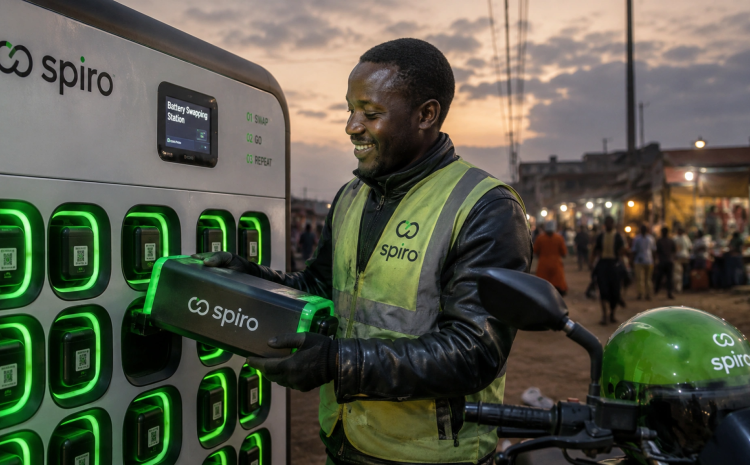
While the car version was failing in the richest markets on earth, the motorcycle version was quietly becoming ordinary infrastructure in some of the conventional ‘poorest’.
Spiro now runs 100,000 electric motorcycles and 2,500 swap stations across 7 markets: Kenya, Rwanda, Uganda, Togo, Benin, Nigeria and Cameroon. It keeps more than 300,000 batteries in circulation, has completed over 30 million swaps, assembles in Kenya, Rwanda and Uganda, and recycles batteries in Nigeria.
It raised $50 million in debt from Afreximbank, Nithio and the Africa Go Green Fund in February 2026, then $215 million in equity in June.
MAX went one better and did the thing African startups are told is impossible. It turned a profit in Nigeria, on 20 cities across 3 countries, assembling 3,600 units a month in Ibadan.
Ampersand runs Kenya and Rwanda. ARC Ride took $5 million from the IFC. Bolt’s boda fleet in Kenya crossed 40% electric last December.
Nobody wrote a press release calling this a revolution. It just happened, one 2 minute swap at a time.
Why it worked here and nowhere else.
Here is the part the failures in California never had.
A commercial rider in Kenya or Uganda earns $10 to $15 on a good day, and fuel eats 40% to 60% of it. Swapping cuts his daily running cost by roughly 40%, about $2. On a $12 day, $2 is not a rounding error. It is the difference between sending money home and not.
Africa did not adopt battery swapping because it was the future.
It adopted it because it was the only affordable present.
That is why the technology that could not survive in a market with cheap gasoline and a reliable grid became routine in a market with neither. The constraint was the product.
Now it climbs a step
Bingo’s E2 is a compact 4 seater carrying 1 fixed battery and 4 swappable packs, good for up to 440 kilometers, swapped in about 2 minutes. Reservations are open at roughly KES 1.8 million with deliveries in Q4 2026. The company plans to import 10 to 20 units this year, start assembling in Nairobi by December, ramp to 100 assembled units, sell 1,500 in 2027 and put 10,000 vehicles on Kenyan roads by the end of 2028. It is backed by Trucks VC, Delta40 and family offices, and it names Kenya and South Africa as its 2 African beachheads.
Read the vehicle class before you read the headlines. The E2 is registered as an L7e heavy quadricycle, not a sedan. This is not a Tesla with a removable floor. It is the smallest possible box that carries 4 people and their shopping, which is precisely why it might survive where the sedans did not.
“We are building a whole ecosystem for ride hailing and last mile delivery drivers to succeed.”
Christian Scheder, Co-Founder
Note what he did not say. He did not say he is selling cars.
The vehicle is not the business.
The station is.
A vehicle sells once. Energy sells every day, to the same person, forever. Spiro’s 2,500 stations and 300,000 batteries are not a motorcycle company’s overhead, they are a distributed utility that happens to own some bikes. Every swap is a metered transaction on infrastructure somebody owns.
Kenya Power can already see it coming. Its special e-mobility tariff prices power at Sh16 a unit at peak and Sh8 off peak, has pulled in KES 382 million between July 2023 and April 2026, and is projected to reach nearly Sh5.9 billion a year by 2030. Only 331 customers are metered on it today, heading for 1,000.
That is a market being built in public, with the meter already installed.
Who wins, who is squeezed, and the gap
Winners: whoever owns swap stations on the routes, local assemblers turning imported kits into jobs, battery second life and recycling operators, and the fleet financier who can underwrite a driver.
Squeezed: petrol stations sitting on boda routes, fuel importers, used vehicle dealers whose whole margin is the 10 year old import, and anyone who bet on plug in charging in markets where the real bottleneck is a distribution network nobody has funded yet.
Now the gap, and it is the biggest one on the board.
Every one of these networks is closed. A Spiro battery does not fit an Ampersand slot. A rider is married to whichever company planted a station near his stage, and a fleet cannot mix. Ampersand is the only operator publicly moving toward an open platform. Somebody has to build the roaming and settlement layer between swap networks, the thing that lets any battery clear on any station and pays the owner automatically. That is not a battery business. That is a payments business wearing overalls, and this continent has built one of those before.
The second gap is money. An E2 costs KES 1.8 million. The driver it is designed for earns $10 to $15 a day. Between those 2 numbers sits an asset financing product nobody has shipped at scale.
The room where this gets decided
Every layer in this story, the assembly line, the station network, the interoperability standard, the credit that puts a driver in the seat, gets decided in conversations between operators, financiers and regulators who are usually in different rooms.
The Business Week Afrika Summit on 1 and 2 October 2026 is where we put them in one.
Secure your seat and join the builders shaping Africa’s energy and mobility layer: https://apps.little.africa/events/105
The man who taught the world to carry a spare battery for its phone has arrived in a city where 2 million riders already carry a spare battery for their livelihood.
He is not bringing the idea. He is coming to where it already lives.