

Congo’s Copper, South Africa’s Monopoly, Kenya’s First Surplus: The Rail Bet That’s Paying Off
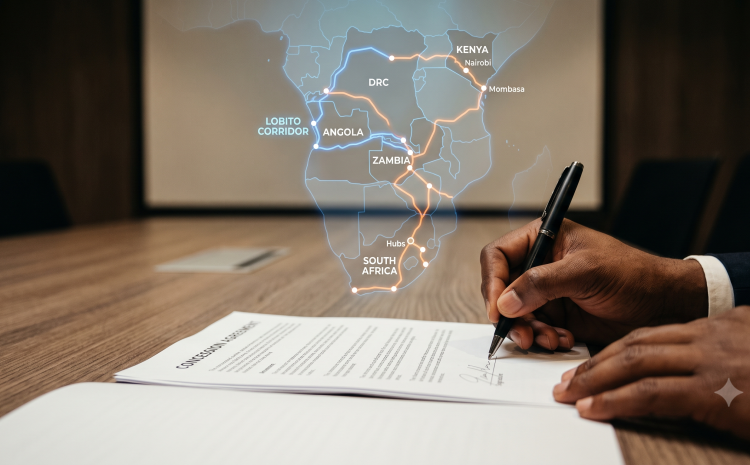
A tonne of Congolese copper reaches the port of Lobito in 8 days. The same tonne, trucked to Durban instead, takes 40 to 50 days if the roads hold. That gap is a decision about who gets paid to move Africa’s cargo, and this month 3 different railways answered it 3 different ways.
None of the news out of Angola, South Africa and Kenya this week was really about trains. It was about who gets to own the track, and what that ownership is now worth.
Angola’s private railway becomes DRC’s copper gatekeeper
A Trafigura-led consortium has run Angola’s Lobito railway under a 30-year concession since 2022, moving copper 1,300 kilometres from the Angolan coast inland to the Democratic Republic of Congo border at roughly €90 to €120 a tonne, against €150 to €200 by truck to Durban.
KoBold Metals has already committed more than 300,000 tonnes a year from its Mingomba deposit, Ivanhoe Mines up to 240,000 tonnes from Kamoa-Kakula, First Quantum and Kobaloni Energy another 170,000 tonnes, a combined 470,000 tonnes locked in before the corridor even reaches its 4.6 million tonne annual capacity target.
The DRC alone produced 3.3 million tonnes of copper and roughly 225,000 tonnes of cobalt last year, more than 75% of the world’s cobalt supply. A $753 million financing package, $553 million of it from the United States’ DFC, keeps the line expanding.
A private company, not a government, now decides how fast Congolese copper reaches a ship.
South Africa finally lets someone else run the trains
For the first time since Transnet was formed, the state’s rail arm has signed access agreements letting 11 private operators onto its national network, among them ARC South Africa, Grindrod and Menar, moving coal, manganese, containers, fuel and general freight.
Combined, they add 24 million tonnes of freight capacity now, scaling toward 52 million tonnes over 5 years, chasing South Africa’s target of lifting rail volumes from under 180 million tonnes to 250 million tonnes by 2030.
R16.8 billion in public investment is already approved, R23.6 billion more is in the pipeline.
“This milestone represents more than just slot allocation, it signals the creation of a functional and competitive rail marketplace.”
Moshe Motlohi, CEO, Transnet Rail Infrastructure Manager.
A monopoly just admitted it cannot move all its own cargo.
Kenya’s most mocked railway turns its first profit
The Standard Gauge Railway posted a Sh181.7 million surplus this year, reversing a Sh1.18 billion loss, its first profit since commercial operations began in 2017, the year critics started calling it the railway to nowhere. Revenue rose to Sh18.5 billion from Sh16.8 billion, freight haulage grew 10.2% to 7.05 million tonnes.
Kenya Railways as the parent corporation still reported a Sh28.17 billion net loss, but Sh25.97 billion of that is interest on the SGR’s own construction debt, not the operation itself, whose loss narrowed 65% to Sh581 million on a record 8.16 million tonnes of freight. The asset works. The financing structure is what still owes.
Judge the railway on what it moves, not on what it once cost to build.
3 governments, 3 different points in a railway’s life, one answer:
Hand the track, or slots on it, to whoever can move the cargo, and collect the tariff instead of running every wagon yourself.
Angola did it at the concession stage, before the first train ran. South Africa did it after decades of running the network alone. Kenya is doing it by default, letting the operating numbers speak once they are finally separated from the debt that built the line.
That separation is the opening. Someone still has to aggregate the small DRC and Zambian mining outputs too small to be an anchor tenant and get them to Lobito’s rail head.
Someone still has to own the wagon fleets South Africa’s 11 new operators need but do not yet have.
Someone still has to build the trucking and warehousing layer that feeds Kenya’s newly profitable line from the farms and factories that are not on the SGR route.
The rail companies captured the corridor. The corridor still needs everyone who is not the rail company.
You do not need to own the mine, the crop or the factory floor to own the margin. Sometimes you just need to own the track that decides whether it moves.
The Business Week Afrika Summit on October 1 and 2 exists for exactly this layer, the operators, financiers and logistics builders who show up before a corridor is fully built out, not after the anchor tenants have already locked in the good margins.
Secure your seat and join the builders shaping what gets built next: https://apps.little.africa/events/105
Copper still leaves the ground in the Congo the way it always has. Who gets paid to move it from there is being decided right now, one concession, one access agreement, one surplus at a time.