

Every African Beneficiation Plan Buys Its Chemicals Abroad. Botswana Is Building The System At Home.
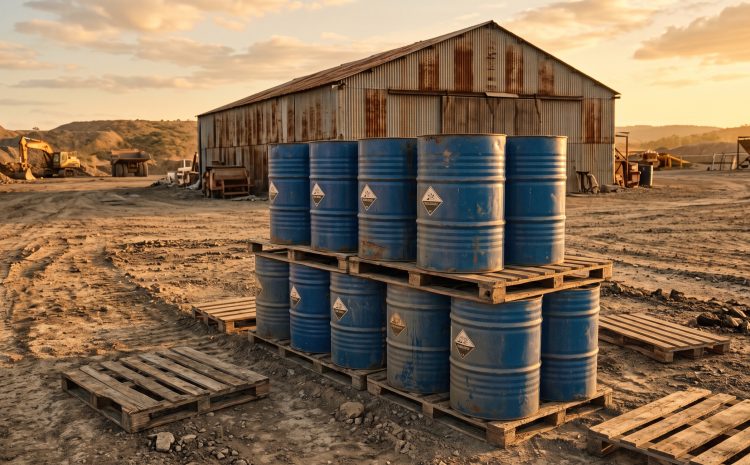
Sodium isobutyl xanthate. Sodium metabisulfite. Sodium hydrosulfide.
3 chemicals nobody outside a mine has heard of. No copper leaves the Congolese or Zambian ground without them.
Follow 1 drum of the stuff.
It is manufactured somewhere else. It is containerized, carried to an African port, cleared, trucked several hundred kilometers inland, and poured into a flotation cell on the Copperbelt, where it does the single job that separates copper from rock.
Then the mine orders another, because a reagent is not equipment. It is consumed. It is bought again next month, and the month after that, for the working life of the mine.
Kemcore’s entire business until now was bringing that drum in.
This month it got environmental clearance to make it instead.
What the drum is actually made of
Kemcore, founded by Calisto Radithipa, has approval for a 140 million dollar plant at the Leupane Energy Hub and Industrial Park in central Botswana. Output is 150,000 metric tonnes a year of those 3 reagents. Financial close is targeted for December 2026, construction for 2027, first production for the first half of 2028.
Now look at the inputs, because the inputs are the whole argument.
Sodium reagents are made from gas, soda ash and salt.
The gas comes from Botala Energy’s coal bed methane project. The soda ash and the salt come from the Botash mine, 300 kilometers up the road.
Botswana was already sitting on every ingredient. It was importing the finished product anyway, and so was everyone else on the Copperbelt, which is the part that should sting.
“Talks with funders are advanced, and we have seen good interest from regional and local institutions, as this is a good opportunity for having exposure to the critical minerals without actually investing in a mine.”
calisto RADITHIPA
Read that sentence twice. It is the clearest investment thesis written on this continent this year.
The second company on a very short list
This is not the first African firm to notice the shopping list. It is the second.
In Egypt, Simplex was started by 2 engineers, Ahmed Shaaban and Mohamed Mansour, out of a university graduation project. It now runs a 50 million dollar, 40,000 square meter CNC machine plant at 10th of Ramadan City and exports to 34 countries.
Simplex sells the machines. Kemcore sells what the machines eat.
They are the only 2 African firms selling the input layer under everybody else’s beneficiation plan, and the second is nearly 3 times the size of the first.
Every value addition policy here has the same blind spot. Ghana sets up a state gold buyer. Gabon dates a manganese export ban. Uganda turns 100 megawatts into fertilizer. Kenya wants its gold refined before it leaves. A Kirinyaga workshop builds a 50 kilogram portable ginnery so cotton is processed where it grows.
Every single one of those plans has to buy its plant, its spares and its consumables from outside Africa.
We have been arguing about owning the next step for 6 years. 2 companies read further down the page and noticed the next step has a shopping list.
Who wins, who is squeezed, and the gap
The winners sell the consumable, not the capital item. A machine is bought once and serviced occasionally. A reagent, a grinding ball, a flocculant, a bag of lime, an assay kit and a filter cloth are bought every month, forever, by a customer who cannot stop buying without stopping production. That is recurring revenue with a physical moat, priced in hard currency.
The squeezed party is unusual here, because it is Kemcore. An importer is deliberately destroying its own import margin, which tells you the manufacturing margin behind it is worth more than the freight and lead time it is giving up. Every mining chemicals distributor between Durban and Dar es Salaam should read that decision as a notice.
The gap is everything else on the list, and it is long. Nobody has published what the Copperbelt actually consumes in a year, by line item, against what Africa can already make. Grinding media. Explosives and initiation systems. Conveyor belting. Mill liners. Laboratory consumables for the assay houses that a proper minerals trade runs on. Each of those is a factory with a captive customer 300 kilometers away and no African supplier named.
The pattern travels. Cocoa needs fermentation equipment. Coffee needs hulling machines and moisture meters. Cotton needs gins. All of it is imported today.
Owning the next step was never a policy. It is a purchase order somebody in Africa finally gets to fill.
That is the trade the Business Week Afrika Summit is convening for. On the 1st and 2nd of October 2026 in Nairobi, the operators running processing plants, the manufacturers who could be supplying them, and the capital looking for minerals exposure without mine risk are in one room for 2 days. If your business could be selling something to a mine, a mill or a refinery on this continent every single month, that room is your order book.
Secure your seat and join the builders: https://apps.little.africa/events/105
A blue steel drum on a wooden pallet in a Kolwezi yard, dust on the lid, a stencil across the side.
And in 2028, the same drum, the same dust, and a stencil that says Botswana.