

Homes in Days, Not Years: Ethiopia Bets the Housing Crisis Is a Manufacturing Problem
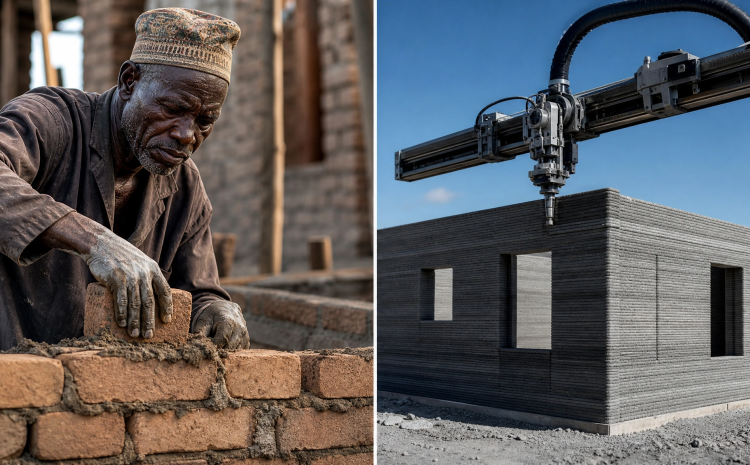
Ethiopia has decided to stop building houses and start printing them.
Prime Minister Abiy Ahmed has announced that the country will deploy 3D printing technology to construct up to 1.5 million homes, importing the printers, establishing local factories, and aiming to raise multi-storey G+3 buildings in roughly a month each. The price tag is staggering: an estimated 3 trillion Birr, close to 20% of the national budget. It is one of the most aggressive bets any African government has made that its housing crisis is not a construction problem but a manufacturing one.
The scale of the problem justifies the scale of the ambition.
The Gap That Numbers Refuse to Hide
Addis Ababa alone carries a housing backlog of around 1.2 million units. Nationally, annual demand runs at 471,000 to 486,000 homes against a supply of roughly 165,000, a shortfall that compounds every single year. Government programmes meet about 2% of demand. Prices in some segments have surged up to 300%, only 23% of home purchases involve a mortgage, and an estimated 72% of urban households live in dwellings built from substandard materials like wood and mud.
This is the maths of a market that conventional construction has failed to serve. Brick-by-brick building is too slow, too labor-intensive, and too expensive to ever close a gap that widens faster than it can be filled. Ethiopia’s wager is that the only way to catch a moving target is to change the machine.
The Proof Already Exists, One Country Over
Ethiopia’s announcement is bold, but it is not unprecedented. In Kilifi, Kenya, a company called 14Trees, a joint venture between building-materials giant Holcim and British International Investment, has already built Mvule Gardens: a 52-home neighborhood where a single printer lays the walls of a two-bedroom house in 18 hours. Homes there start at around $28,000.
The contrast is the real story. Kenya offers bottom-up proof: private capital, a proven unit, a finished neighborhood you can walk through. Ethiopia offers top-down ambition: state scale, 1.5 million units, a national budget line. One has demonstrated that the technology works at the level of a house. The other is betting it works at the level of a country. The space between those two facts is where the opportunity lives.
Where the Money Actually Lands
Here is the part builders should read twice. A printer does not pour its own cement, mine its own aggregate, or wire its own houses. Ethiopia is importing the technology, but it has openly flagged a shortage of iron and a need to ramp up domestic production of cement, glass, and other inputs.
That is a market.
The bottleneck in 3D-printed construction shifts from labour to materials and operations, and that shift opens doors. Local cement and aggregate producers gain a buyer with a national mandate. Glass and fittings manufacturers gain demand at industrial volume. A printed wall still needs roofing, plumbing, electrical, and finishing, which means the trades do not disappear, they re-sort. And the printers themselves need operators, technicians, and maintenance crews who do not yet exist in the numbers required.
Who gets disrupted?
The traditional block-and-mortar contractor whose advantage was cheap labour, and the importer whose business depended on the country never making its own inputs.
Who wins?
Whoever builds the domestic supply chain and service layer beneath the machines.
The signal is continent-wide. Nearly every African capital carries a housing deficit measured in the millions. Ethiopia and Kenya are running the two halves of the same experiment, scale and proof, in public. The entrepreneurs who win will not be the ones who own the printers. They will be the ones who feed them, finish behind them, and keep them running.
The machine is arriving. The supply chain around it is still unbuilt.
The next decade of African housing will be won by builders who see infrastructure shifts before they become headlines. The Business Week Afrika Summit on 1st and 2nd October 2026 is where those builders, the operators, suppliers, and financiers reshaping how the continent gets built, meet to map what comes next. Secure your seat.
#TwendeBWA