

Nigeria Has 8,000 Pilots. It Cannot Afford to Fly Them.
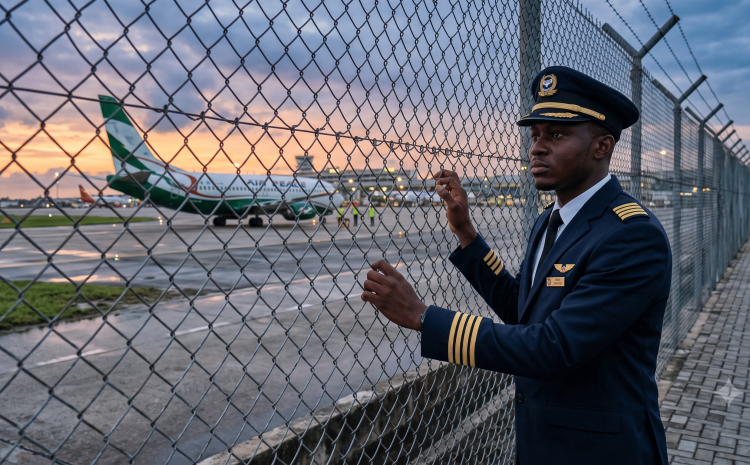
Captain Zino Mario has more than 8,000 aspiring pilots in his network. Most of them hold a commercial license.
Almost none of them hold a job.
This is NOT a training problem
“Nigeria’s biggest pilot workforce challenge is not producing commercial pilots. It is converting qualified commercial pilots into airline pilots.”
Captain Zino Mario, CEO, Zino Aviation.
The country trains pilots. Flight schools graduate them every year. What stops there is the next step nobody warns a cadet about at enrollment: the type rating, the certification that lets a licensed pilot actually fly a specific commercial aircraft. Airlines used to pay for that themselves, the cost of building a workforce. Now the vast majority of Nigerian carriers hire only pilots who already hold one, and leave new graduates to find $15,000 to $25,000 for a commercial type rating, or $30,000 to $50,000 for a private jet rating, on their own.
The bill before the job
Getting to that point already cost real money. Training runs $45,000 to $60,000 in South Africa, $70,000 to $110,000 in the United States, €75,000 to €120,000 in Europe, before a single type rating is added on top.
“Type ratings are expensive, creating a significant financial barrier for many newly qualified pilots.”
Captain Zino Mario, CEO, Zino Aviation.
A First Officer who clears that wall can expect N1.5 million to N3.5 million a month, a Captain N6 million to N18 million. The salary is real. The problem is getting hired long enough to earn it.
Who wins from this
The gap is not the license. It is the bridge between the license and the cockpit, and nobody has built a product to finance it.
A pilot with a job offer contingent on a rating he cannot afford is exactly the kind of borrower an income share agreement or a type rating loan fund was built for: predictable future salary, a specific dollar amount, a fixed timeline.
Aircraft lessors already sit inside this market financing the planes. A builder who finances the people who fly them is filling a gap the airlines created and no longer want to close themselves.
Who gets squeezed: the 8,000 pilots stuck holding a license nobody will convert, and the flight schools training a supply chain with no bridge at the far end.
Bigger, not smaller
“The pathway from training to employment is still less structured,”
Mario says, comparing Nigeria to South Africa, Ethiopia and Kenya, where the systems are further along. That gap is about to matter more, not less.
Boeing’s 2026 outlook puts Africa’s aviation workforce need at 75,000 professionals by 2045: 22,000 pilots, 25,000 maintenance technicians, 28,000 cabin crew, against a services and support market Boeing prices at $140 billion. The pilots to fill those seats already exist. What is missing is the financing that lets them cross from license to cockpit.
This is not a skills gap. It is a financing gap wearing a training costume, and it is about to get more expensive to ignore.
The kind of product that closes a gap like this, structured financing against a real future salary, gets built by people who have already found each other: aviation financiers, fintech builders, the airlines themselves rethinking what they used to pay for. The Business Week Afrika Summit on October 1 and 2 is built to put those people in the same room.
Secure your seat and join the builders shaping what gets financed next: https://apps.little.africa/events/105
Zino Mario counted his network at over 8,000 pilots and stopped there. Somebody still has to count the checks. Will you write the one that gets a licensed pilot into a cockpit.