

The Ice Business: What a $6,000 Machine and 40°C Heat Taught Kenya About Unsexy Money
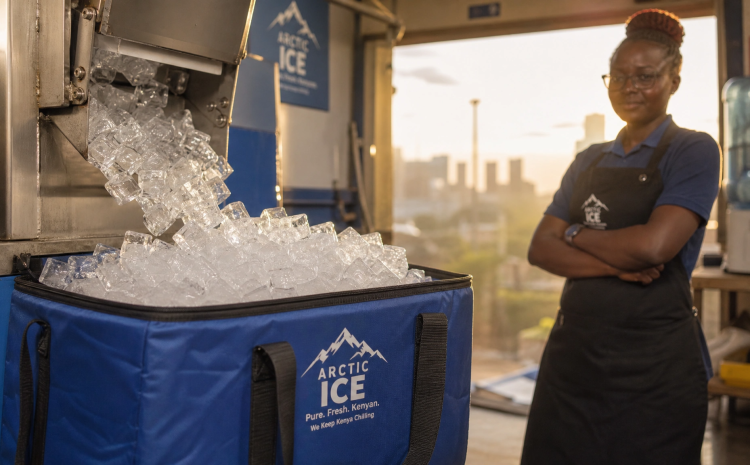
The most instructive business story in Kenya this week is not about AI, fintech, or venture capital. It is about frozen water.
The Demand Was Visible Before the Business Existed
In 2015, Gladys Anyango was working in Juba, South Sudan, where temperatures routinely hit 40°C. She watched the market around her pay almost anything for chilled water and cooling. She was not an engineer or a manufacturer, her background was air ticketing, business administration, and supply chain work in Nairobi. What she had was the discipline to treat what she was seeing as data.
In 2016, she invested $6,000 in an ice-making machine. When she returned to Kenya in 2019, into the teeth of the COVID-19 economy, she launched Glad-Ice Enterprises from home, finding her first customers through Facebook.
The Numbers Behind Frozen Water
Today the business runs from Ndwaru along Naivasha Road and produces 150 kg of ice daily through industrial machines fitted with multi-stage water filtration. Weekend demand peaks at 250 to 300 kg. She employs 3 staff.
The economics are the story. Monthly operating costs run at roughly Sh74,000. Monthly profits exceed Sh100,000. That is a margin approaching 59%, a number most venture-backed startups on the continent have never seen and may never see. Her customers are clubs, bars, restaurants, fisheries, and hospitality businesses: buyers with recurring, weather-proof, week-in week-out demand.
Her operating rules read like a counterweight to the era of growth-at-all-costs: validate demand before major investment. Market first, manufacture second. And on quality,
“Reputation is only as good as the last bag delivered.”
The Bigger Market Hiding Inside the Small One
Glad-Ice looks like a micro-business. It is actually a single visible node in one of the largest unbuilt markets in the region: cooling.
Kenya loses an estimated $578 million worth of food every year to post-harvest losses, with 30 to 40% of production never reaching consumers. Over 65% of rural Kenya has no access to any temperature-controlled storage at all. The country’s cold chain market was valued at roughly $321 million in 2023, and is projected to reach $2.1 billion by 2030. Avocado losses run at 35% in the domestic market against 15% in export channels, purely on the strength of post-harvest handling.
Every bag of ice Anyango sells to a fishery is the informal economy pricing that gap in real time. The fisheries buying her ice are doing so because the formal cold chain never arrived.
The Signal for Builders
The pattern here repeats across the continent: the businesses that look mundane are sitting on demand that is structural, recurring, and almost entirely unserved. Cooling, storage, water filtration, last-mile cold logistics, these are not pitch-deck categories, which is precisely why the margins are still intact.
Who wins from this shift? The operators who enter cooling at any scale, from a $6,000 machine to solar-powered cold rooms, while the market is still pre-institutional. Who gets displaced? Nobody yet, and that is the point: this is white space, not a knife fight. The gap for the African entrepreneur is the entire distance between a 59% margin ice business in Ndwaru and a $2.1 billion cold chain market that does not exist yet.
The opportunity was never hidden. It was just unglamorous.
The builders winning in Africa right now are the ones who validate demand before they spend, and who treat unsexy gaps, cooling, storage, logistics, as the structural markets they are. The Business Week Afrika Summit on 1st and 2nd October 2026 brings those operators, and the investors learning to take them seriously, into the same room. Secure your seat.
#TwendeBWA