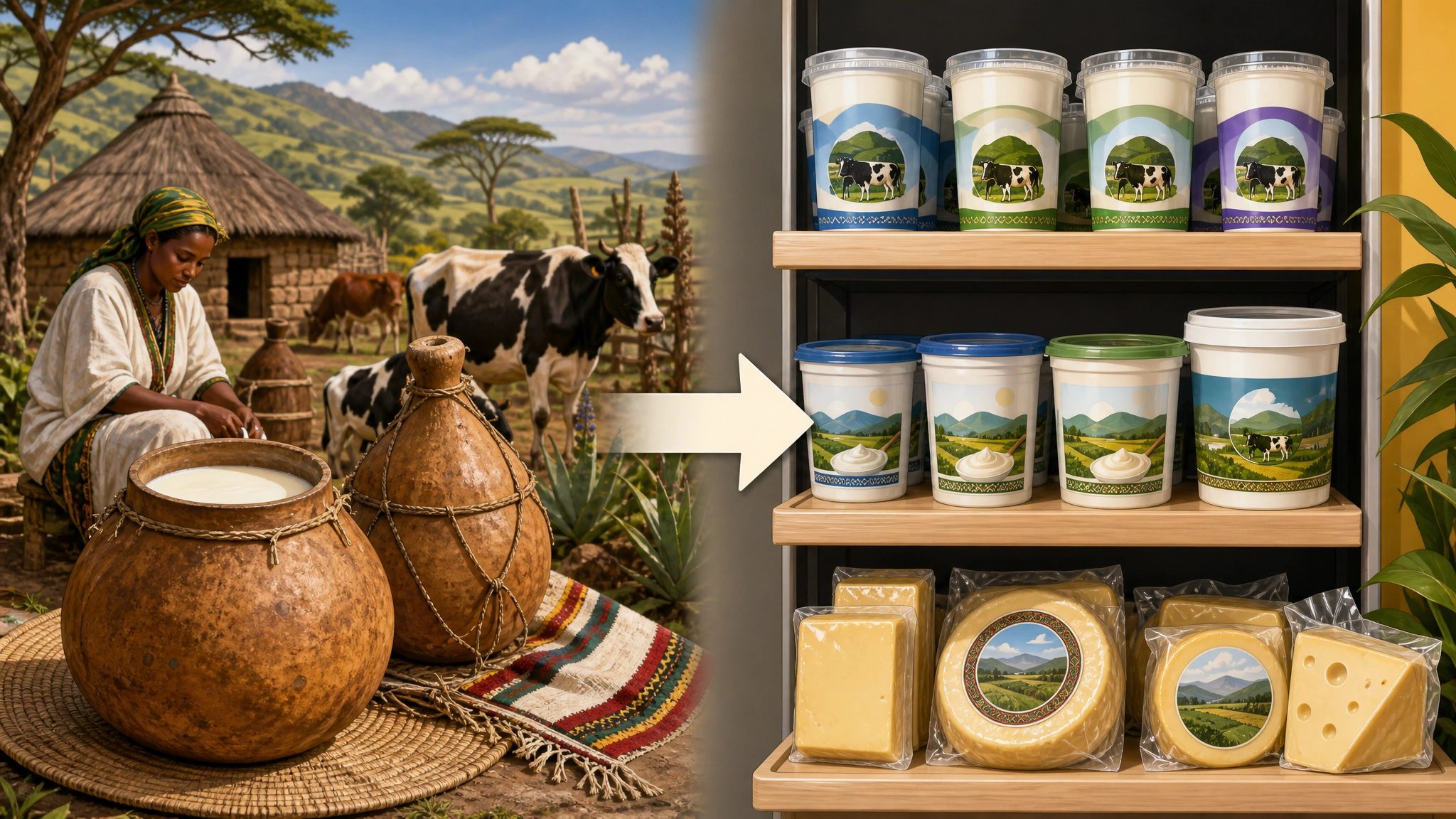
Ethiopia produces 12 billion litres of milk every year. It also spends approximately $50 million annually importing dairy products: powdered milk, butter, cheese, and tens of millions more importing the starter cultures needed to process the milk it already has.
Read that again, slowly. A country sitting on one of the largest dairy production bases on the continent is paying foreign suppliers for the tools to convert its own milk into value.
This is not an Ethiopian problem. It is an African pattern.
The Probiotic That Proved the Point
Last month, Ethiopia’s Institute of Agricultural Research introduced Etittuu, a domestically developed probiotic starter culture derived from traditional fermented milk products like ergo. It ferments pasteurized milk into yoghurt and cheese in 4 hours. It is produced locally. It replaces an import.
The government framed it as part of the Yelemat Tirufat initiative, “Bounty of the Basket”, which has already established over 15,900 dairy development villages across the country. The vision is vertical: produce more, process more, import less.
Etittuu is not a headline innovation. It is a research institute catching up to what local entrepreneurs should have been building for a decade. But its significance is not in the technology. It is in what it demonstrates: the step was skippable all along. Ethiopia had the milk. It had the fermentation tradition. It had the consumer demand. What it lacked was the institutional and entrepreneurial focus on owning the conversion step, the moment where raw production becomes processed product, and where the majority of the margin lives.
The Same Story, Different Industries
Nigeria’s internet infrastructure tells an almost identical story at the digital layer.
Despite substantial investment in connectivity, significant amounts of domestic internet traffic between Nigerian users still route through overseas networks before returning home. Data generated in Lagos travels to servers abroad and comes back, accruing foreign currency transit costs, exposing Nigerian user data to external legal jurisdictions, and adding latency that fintech platforms and streaming services pay for in performance.
The country is commissioning hyperscale data centres. It has an Internet Exchange Point. Major platforms including Meta, Microsoft, and Google have begun routing traffic locally. And still, the default infrastructure sends Nigerian data abroad before it comes home. Technology policy adviser Jide Awe has been direct: Nigeria needs stronger local-first routing, lower interconnection costs, and policies that make keeping traffic local the economically rational choice.
The parallel to dairy is exact. Nigeria generates the traffic. It exports the raw signal. It imports the processed connection back. The value in security, speed, cost efficiency, and economic sovereignty, sits in the middle step that is not being owned.
Zoom out further and the critical minerals story completes the picture. Africa holds a significant share of the world’s lithium, cobalt, and rare earth deposits, the raw materials that power electric vehicles, smartphones, and renewable energy infrastructure. The extraction happens here. The refining, the cell manufacturing, the finished product, almost entirely elsewhere. The continent that supplies the inputs buys back the outputs at a markup it had no hand in setting.
Why the Step Gets Skipped
The easy explanation is capital: processing infrastructure is expensive to build. But Etittuu came from a research institute, not a venture fund. Nigeria’s IXPN was built with policy intent, not private capital alone. The critical minerals processing plants that do exist on the continent, in Zimbabwe, in South Africa, in Morocco, were built when governments or entrepreneurs decided the downstream step was worth fighting for.
The harder explanation is incentive architecture. For decades, it was easier and more immediately profitable to extract and export than to process and sell finished goods. Global commodity markets were designed to reward the raw step. Trade structures, foreign exchange regimes, and infrastructure gaps made the next step feel out of reach.
What has changed is the calculation. The Dangote Refinery just demonstrated what owning the processing step does to an import bill at national scale, Nigeria’s petrol import expenditure collapsed 96% in a single quarter. Etittuu is doing it at the agricultural layer. A future entrepreneur building local routing infrastructure in Lagos will do it at the digital layer.
The pattern is breakable. It just requires someone to decide to own the next step.
The Question for Builders
The most defensible African businesses of the next decade will not be built at the extraction or production layer. They will be built at the conversion layer. The step between what Africa already produces at scale and the finished product the world buys.
Dairy processing. Digital infrastructure. Mineral refining. Agricultural commodities. Data sovereignty. Each of these has a raw step that Africa owns and a value step that it is currently paying someone else to perform.
The opportunity is not abstract. It is the specific distance between what exists and what is being imported to replace it.
The question every entrepreneur should be sitting with today is a simple one:
In your industry, which step are you stopping at?
The most profitable layer in any value chain is rarely the one Africa currently owns. At the Business Week Afrika Summit on October 1st and 2nd, 2026, the conversation is about moving up, building the businesses that convert what Africa produces into what the world pays a premium for. If you are a founder thinking about where the real margin lives in your industry, this is the room that will sharpen that thinking.
#TwendeBWA