

Dangote’s Gamble Paid Off. Now Every African Entrepreneur Should Study the Method.
Aliko Dangote is worth $36.7 billion.
He is Africa’s richest person. The wealthiest Black individual on the planet. And the number, as striking as it is, matters far less than how it was built.
For decades, Africa has been a continent that ships its wealth outward in its rawest form.
Crude oil.
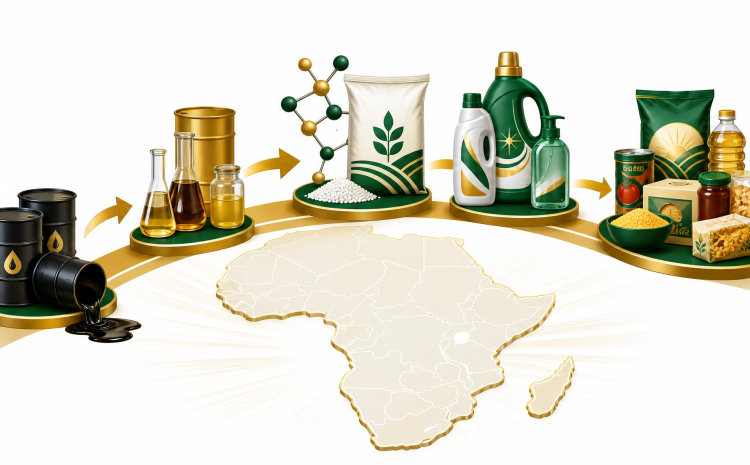
Leaving Nigerian shores to be refined elsewhere, agricultural commodities leaving West African farms to be processed into consumer goods in European factories, mineral ores leaving Southern African mines to be manufactured into finished products in Asian plants. The wealth extracted from Africa’s resources has, in large part, been captured by whoever built the refinery, the factory, the processing plant.
Dangote looked at that dynamic and built a refinery.
His $20 billion Lagos refinery, the largest single-train refinery in the world at 650,000 barrels per day, didn’t just make him richer. It rewrote a national story. Nigeria, one of Africa’s most significant oil producers, had spent decades importing the very fuel it drilled. Today, it is a net petroleum exporter of refined products, shipping approximately 44,000 barrels of refined fuel daily to Côte d’Ivoire, Cameroon, Tanzania, Ghana, and Togo. The refinery is already producing linear alkyl benzene for detergent manufacturing, a downstream industrial chain that didn’t exist locally before.
He’s not stopping. A $11.5 billion expansion programme, using Honeywell technology, is targeting a doubling of refinery capacity by 2029, with a long-term ambition of 2.1 million barrels per day of global refining capacity. In Tanzania, a refinery is under construction in Tanga, four to five years from completion. In Ethiopia, a $2.6 billion fertilizer plant, a joint venture with Ethiopian Investment Holdings, is projected to produce 3 million metric tons of urea annually by 2029, backed by a $4.3 billion gas supply agreement with China’s GCL Group.
The cement business tells the same story. Dangote Cement, the most valuable company on the Nigerian Stock Exchange at N20.1 trillion, posted profits exceeding N1 trillion in a single fiscal year. Its share price rose 162% over twelve months, even as Nigeria’s currency faced significant headwinds. Industrial-scale producers with local supply chains are structurally insulated in ways that import-dependent businesses are not.
The Class Behind the Blueprint
Dangote is the headline, but he is not alone.
Across the continent, a generation of African energy executives is carrying the same thesis into their sectors. Africa’s seven largest refineries are today led by executives with combined decades of international experience from Stanford MBA holders to engineers with three advanced degrees, now deployed not in Houston or Rotterdam, but in Lagos, Cairo, Algiers, and Johannesburg.
David Bird leads the Dangote Refinery. Simon Baloyi, co-chair of the B20 Energy Mix and Just Transition Task Force, leads Sasol in South Africa with a capacity of up to 300,000 barrels per day. Bashir Bayo Ojulari, a 30-year petroleum engineer who built his career at Shell, now leads NNPC. Dr. Mohamed Saad leads Egypt’s Mostorod refinery with a doctorate in chemical engineering. Together, these seven executives oversee nearly 1.8 million barrels per day of processing capacity on the continent.
Their collective mandate is the same: reduce imports, strengthen energy security, and build the downstream industrial chains that define the wealth of nations.
What the Blueprint Is Actually Saying
For African entrepreneurs, the Dangote story is not primarily about oil. It is about a direction of building.
The import replacement thesis is the core insight: wherever Africa is currently spending money importing something it could produce, there is a business. Refined fuel, pharmaceuticals, processed food, fertilizers, industrial materials, every category is a potential play at the right scale. The question is not whether the opportunity exists. The data has answered that.
The question is whether the builder is willing to bet on African demand as the market, rather than waiting for African supply to find foreign customers.
The continental expansion model is equally instructive. Dangote’s wealth is not in one market. It is in owning infrastructure across Nigeria, Tanzania, Ethiopia, and the export corridors between them. Scale creates insulation. Diversification across African markets creates resilience no single-country play can replicate.
The simplest version of the lesson: Africa’s largest fortunes are being built by people who chose to add value here, for people here, before sending anything outward.
The question the next generation of African entrepreneurs should be sitting with: where is my industry’s unbuilt refinery?
These are precisely the questions Business Week Afrika will be putting on the table at the BWA Summit, 1st & 2nd October 2026.
#TwendeBWA