

Two Layers, One Problem: Why Africa’s Entrepreneurs Are Building in the Dark
On Saturday, June 6, 2026, MTN Nigeria invited the public into a courtroom.
Not a real one, but close enough. At their Lagos headquarters, the continent’s largest mobile network staged an event called Data on Trial, a public hearing where customer complaints about vanishing data and poor network quality were put to an independent jury. KPMG presented a billing audit. Executives took hard questions. Customers testified. One woman, Hannah Ajibade, described losing her job because she couldn’t rely on her data connection.
It was an unusual move for a corporation, part transparency exercise, part PR event, part acknowledgement that something had broken down between what Africa’s digital entrepreneurs need and what its infrastructure can currently deliver.
The Infrastructure Confession Hidden in the Defense
MTN’s CEO Karl Toriola didn’t come to apologize. He came to explain.
The 50% tariff increase that triggered nationwide outrage?
“Implemented for the network to survive.”
The data bundles that customers say deplete impossibly fast?
KPMG found no systematic overcharging.
The poor service quality?
MTN’s network absorbs 25 fiber cuts daily from vandalism.
The company invested N900 billion in 2025 and over N1 trillion in 2026, spending more than it earns in profit on infrastructure.
Toriola’s most direct statement came when asked about unlimited data plans:
“The issue of unlimited data on mobile network, it does not exist anywhere in the world, except you are paying $400 a month.”
He compared offering cheap unlimited data to subsidizing airline tickets indefinitely. Structurally impossible without collapsing the system providing the service.
The public reception was divided. Some praised MTN for the transparency. Others called the influencer-filled audience “gaslighting.” What got less attention in the debate was the structural admission embedded in Toriola’s defence:
The infrastructure required to serve Africa’s digital ambitions does not yet exist at the scale needed. MTN is investing billions. The gap is still widening.
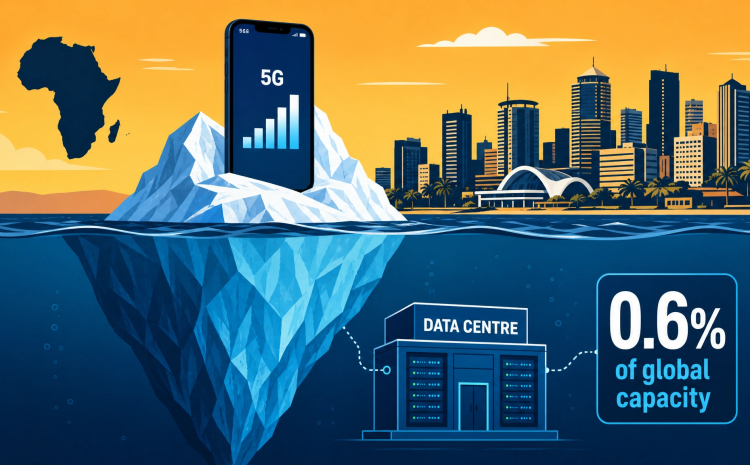
One Layer Down: The Data Centre Problem No One Is Talking About
MTN’s infrastructure challenge sits at the connectivity layer: the towers, the fiber, the spectrum, the last mile between the network and the device in an entrepreneur’s hand.
But there is a second layer underneath. Africa accounts for 0.6% of global data center capacity.
The continent’s cloud storage, its AI compute, its application hosting, its backup infrastructure, the vast majority of it runs on servers sitting in Frankfurt, Ashburn, or Singapore. When a Kenyan fintech processes a transaction, there is a meaningful probability that the data leaves the continent and returns. When a Lagos startup trains a machine learning model, the compute almost certainly lives abroad.
Richard Muthua, Executive Head of Cloud and Cyber Security at Liquid C2 Kenya, put it plainly in a June 2026 analysis: local data infrastructure isn’t just a compliance convenience. It is the difference between a digital economy that can innovate fast and one that can’t. Kenya’s Data Protection Act already creates legal obligations around data residency. AI and real-time applications, speech processing, video analytics, predictive modelling, are highly sensitive to latency. And crucially: *infrastructure sitting closer to markets makes it easier for startups to experiment.*
The argument is the same one Dangote made about oil. If the processing layer lives elsewhere, so does the value.
The Two-Layer Gap African Entrepreneurs Are Actually Building On
The MTN story and the data centre story are the same story told at two different altitudes.
At the top: the mobile connectivity layer, degraded by vandalism, under-investment, and pricing politics, even as telecoms pour billions in to close the gap.
Underneath: the compute and storage layer, 0.6% of global capacity, in a continent producing some of the world’s fastest-growing digital economies.
Together they describe an infrastructure reality that every African entrepreneur building a digital product, service, or platform is navigating daily, often without naming it. The app that loads slowly. The payment that times out. The video call that drops. The data bundle that runs out before the work is done. These are not random frustrations. They are symptoms of a structural gap between African digital ambition and the physical infrastructure beneath it.
Understanding this gap is not cause for despair. It is a map.
The entrepreneurs building network-efficient products, lightweight applications, offline-first tools, and local cloud alternatives are not working around a temporary problem. They are building for the actual condition of the continent’s digital infrastructure, which, for the foreseeable future, will remain constrained, expensive, and unevenly distributed.
MTN put data on trial. The verdict revealed something more important than whether a CEO overcharged anyone:
Africa’s digital economy is being built on a foundation that is still under construction.
The builders who understand that aren’t waiting for it to be finished. They’re building with it in mind.
These are precisely the conversations Business Week Afrika will be putting on the table at the BWA Summit, October 2026.
#TwendeBWA