

A Nairobi Bank Lent 819 Billion Shillings On Behavior And Lost Less Than Everyone Else
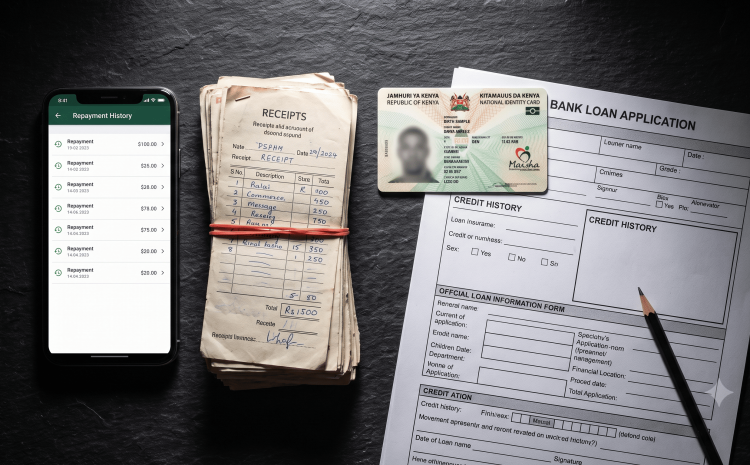
28 million Kenyans have borrowed money from the same lender and paid it back.
4.5 million of them earned a credit score for doing it.
Not one of them can take it anywhere.
What they tell you about the African borrower
The story goes that the informal trader cannot get credit because she has no history. No registration, no audited books, no collateral, no file. Formalize her, the argument runs, and the money will follow. Register the business, issue the certificate, open the ledger, and the bank will finally be able to see her.
Here is what is actually true.
She has a repayment history. It is longer, denser and more predictive than the one most formally registered businesses can produce. 3 separate institutions have now built that history, at national scale, in 2 countries. All 3 are sitting on it.
The state built the file and then locked the drawer.
Kenya’s Hustler Fund has disbursed 90 billion shillings to 28 million borrowers across 3 products, running at roughly 50 million shillings a day. Cabinet Secretary Wycliffe Oparanya reported the rest of it to President Ruto:
- 10 million repeat borrower histories
- 4.5 million A and B credit scores earned purely through repayment behavior
- 7 billion shillings of accumulated savings
Read that number again. A quarter of Kenya’s population has a behavioral credit file, generated by the state, sitting in a state system.
Now try to use it. A borrower who repaid 12 times cannot walk into a bank and show it. The score exists, it is graded, it predicts, and it is not portable.
It is a reference letter she is not allowed to carry.
Around that file sits the population it describes. The Kenya National Bureau of Statistics counts 18.1 million informal jobs, 84% of the country’s 21.6 million total employment.
Kenya’s platform economy alone is worth about 133 billion shillings and supports an estimated 1.5 million workers, every one of them accumulating a payout record inside somebody else’s app.
The file does not travel.
A bank already proved the file works.
NCBA posted 12.4 billion shillings in net profit for the first half of 2026, up 12.2%. Deposits closed at 551 billion, assets at 739 billion, return on average equity at 19%.
The number underneath those is the one that ends the argument.
NCBA disbursed 819 billion shillings in digital loans in 6 months, up 26.9% year on year, almost all of it through M-Shwari and Fuliza on Safaricom’s rails. Mobile banking carried 94% of the group’s transaction volumes.
It carried that book at a non performing loan ratio of 10.5%, against an industry average of 15.3%.
A tier 1 bank lent hundreds of billions of shillings against transaction behavior and lost a third less of it than the market loses on conventional, registered, collateralized lending.
This is no longer a claim about the informal economy. It is an audited result. Behavior underwrites better than paperwork, and the bank that figured that out is the most profitable digital lender in the region.
Then notice the shape of it. That book is a single product, in a single country, on a single telco’s rails. NCBA’s regional subsidiaries in Uganda, Tanzania and Rwanda grew lending 25% and delivered 1.6 billion shillings of profit, but the behavioral book that produced the 819 billion is a Kenyan book, on a Kenyan network, and a customer who builds a record inside it owns nothing she can carry out.
The file does not travel.
Nigeria has the same drawer and the same lock.
The Nigerian Consumer Credit Corporation, CrediCorp, was set up in April 2024 to push consumer credit into a market where almost nobody has it. As of 31 July 2026 it has moved 47.2 billion Naira to 301,928 Nigerians, with a stated ambition of reaching half the working population by 2030.
The market it is pushing into: 6% of Nigerian adults used credit from a regulated financial institution in the past year. 26% are financially excluded outright.
So CrediCorp is manufacturing exactly what the Hustler Fund manufactures. 301,928 repayment records on people the formal credit bureau cannot see, held by a government corporation, unreadable by the lenders who would need them.
Tunde Ogundipe, who runs the Lagos firm E-doc Online, has said the quiet part in public.
“Access to credit starts with access to credit data.”
TUNDE Ogundipe, E-doc Online
His point is that the Federal Government’s lending schemes will not stall for lack of money. They will stall because a lender asked to underwrite the next borrower has no way to read what the last 301,928 already proved. His proposed mechanism is open banking: let the customer carry her own transaction history to whoever will price it.
From Nairobi the same week, Strathmore Business School’s David Mathuva made the twin argument, pointing at Fuliza in Kenya and Songesha in Tanzania as the pattern that works, on a continent whose median age is under 20.
The file does not travel.
3 countries. 2 state rails. 1 tier 1 bank.
Every one of them has proved that informal repayment behavior is a better credit signal than formal registration. Not one of them has built the thing that lets a borrower take that proof across the street.
Meanwhile, the old prescription is still being written. Lagos State has signed an agreement to convert its danfo operators into a regulated franchise system, moving the unions into cooperative structures under LAMATA oversight, with digital fare payments on selected corridors. LAMATA’s Abimbola Akinajo framed it carefully.
“Formalization should not be construed as strangulation.”
ABIMBOLA Akinajo, LAMATA Managing Director
Kenya’s KCB has put 160 billion shillings behind women led businesses and paired it with the same standing instruction: formalize first, then borrow.
Both are answering a question a bank in Nairobi has already answered differently, with audited numbers, at a lower loss rate.
Who wins, who is squeezed, and the gap
The winner is the lender who can read a file it did not create. Any bank, microfinance institution or asset financier holding a thin book today is 1 data rail away from underwriting a population that has already demonstrated it repays. NCBA’s 10.5% is the business case, and it is public.
The squeezed are the incumbents whose advantage is the credit bureau. If behavioral data becomes portable, a 40 year lending relationship stops being a moat and starts being a legacy cost. The registration industry built around formalization gets squeezed too, because its whole premise is that legibility requires a certificate.
The gap is a product nobody on this continent is selling.
Credit file portability. The rail that lets a Hustler Fund score, an M-Shwari repayment record, a Glovo rider’s payout history or a CrediCorp file move, with the borrower’s consent, to any lender willing to price it. Consent and identity resolution at one end, a scoring standard lenders will accept at the other, and a business model that charges the lender rather than the borrower.
The pieces exist. Nigeria has an open banking framework. Kenya has 4.5 million scored files and a bank publishing the loss rate that justifies reading them. Tanzania has Songesha. What is missing is the company that connects them, and the reason it is missing is unglamorous: no large institution is currently bleeding badly enough to fund it. The bank with the 10.5% loss rate is winning precisely because the file cannot travel.
Which means this one gets built by a founder, or it does not get built.
The room where the file gets its passport
The Business Week Afrika Summit on 1 and 2 October 2026 is built for the conversation this story is missing. The bank sitting on the loss rate, the state fund sitting on the scores, the regulator writing the open banking rules and the founder who wants to move data between all 3 do not currently share a room, a table or a language. That gap is not a technology problem. It is a proximity problem, and it is the one thing a summit actually fixes.
Secure your seat and join the builders turning proof into product: https://apps.little.africa/events/105
There is a woman in Nairobi who has repaid 40 small loans without missing one. Her lender knows it. The state that lent to her knows it. She cannot prove it to anybody else on earth.
Somebody has to build the road out of that drawer.
Then the file travels.
Business Week Afrika.