

Africa’s Biggest Trade Barrier Just Fell. Are You Walking Through It?
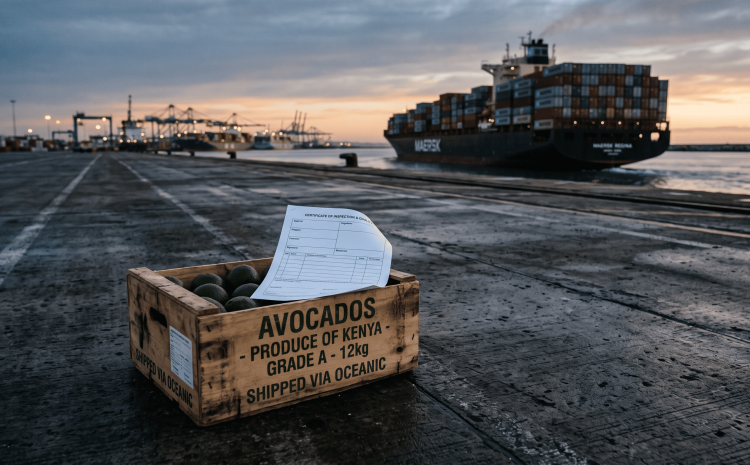
On 1 May 2026, 24 tonnes of South African apples cleared Shenzhen Bay Port and paid nothing.
They were the 1st shipment through China’s zero tariff policy, which that morning took effect for 53 African countries. In the 2 months that followed, China’s imports from Africa reached 193.8 billion yuan, about $28.72 billion, up 23.5% year on year.
Avocados rose 130%. Apples rose 89.6%. Oranges rose 27.9%. Beijing had also granted unified regional quarantine access for African chilies, coffee, cashew and wild aquatic products, so a Rwandan chili exporter no longer waits on a bilateral negotiation to sell into the world’s 2nd largest economy.
You have been told for years that African goods cannot reach global markets because rich countries build walls against them.
The largest wall on earth just came down. Most of the continent still cannot get through it.
Now rewind to the border
Nigeria’s agricultural exports fell 31.2% in Q1 2026, to N1.172 trillion from N1.704 trillion.
That is roughly N532 billion gone in 3 months.
The reasons published alongside the collapse are not tariffs and not demand. They are port delays, excessive pesticide application, outdated preservatives, and failure to obtain required phytosanitary certification. Industry estimates put the share of Nigerian agro exports rejected abroad at about 30%. The destinations at risk are Asia at N529.45 billion and Europe at N500.34 billion, which is to say the markets that were already open.
Abuja’s answer arrived on 28 July, when Budget Minister Abubakar Atiku Bagudu inaugurated an interministerial committee on the Nigerian Agricultural Quarantine Service, seating Customs, the national accreditation system, the farmers association and the freight forwarders around one table. Its terms of reference are laboratory capacity, infrastructure, funding and compliance strategy.
Read that again. It is a government assembling, from scratch, in 2026, the ability to certify that a bag of cocoa is what the bag says it is.
Rewind again, to the certificate
The certificate is not a single document. It is a growing stack, and every major market now demands a different page of it.
On 24 July the United States Trade Representative closed 60 forced labor investigations and split the world in 2. The 41 economies judged not to enforce forced labor import prohibitions pay 12.5%. The 19 that do pay 10%. South Africa sits among the 41, alongside China, Japan and South Korea.
The European Union asks a different question, about deforestation, and Nigeria’s Johnvents Group answered it the hard way. To keep selling cocoa into Europe, founder John Alamu’s firm screened 50,000 farms for deforestation risk and enrolled 150,000 farmers, reporting against GRI 13 to satisfy the EU Deforestation Regulation, the corporate sustainability rules and Rainforest Alliance at once.
Johnvents did not buy that capability. It built it in house, because there was nobody to buy it from.
Rewind once more, to the farm gate
Here is where the money actually leaves, and it leaves long before any customs officer sees the shipment.
Tanzania exports more than 70% of its cotton lint. About 75% of that lint sells at a discount, because water and sand are mixed into the crop before it is bought, inside a 7 grade system whose top grade sets a world pricing benchmark. The Cotton Board’s Dotto Ntumba says it plainly. The crop is good. The handling is not.
No foreign regulator is involved in that loss. No tariff caused it. Somebody added water to a bale, and 3 quarters of a national crop went to market at a price nobody had to negotiate down.
Nigeria loses N532 billion a quarter at the border.
Tanzania loses its margin before the crop reaches one.
Here is the part that matters
The tariff was never the wall. The wall is proof, and it is built at the farm gate.
Zero tariff. 53 countries. 1 missing profession.
Across the continent, every time the verifying function is needed, it is supplied by a state agency, a university, or somebody else’s research money.
Nigeria’s quarantine service is being rebuilt by a committee of ministries. Nairobi was just named the Green Climate Fund’s regional hub for eastern and southern Africa, and in the same week the National Treasury’s own head of climate finance, Peter Odhengo, warned that without local technical capacity the office risks being a scenic savannah backdrop for workshops.
Johnvents built its own auditor.
None of those gaps was filled by a company selling the service.
That is not a hole in the evidence. That is the business.
Who wins, who is squeezed, what gets built
The exporters who win are the ones who can hand a buyer a document instead of a promise. Nigeria’s Sunbeth Global Concepts spent 9 years moving more than 200,000 tonnes of cocoa and 60,000 tonnes of cashew into the United Kingdom, Europe and Asia, and this month collected investment grade ratings from Agusto and Co. and Intelligence Africa.
Legibility has become an asset class.
The ones being squeezed are the aggregators whose whole margin came from knowing a buyer, in a market where knowing a buyer is no longer the scarce thing.
The gap is a machine and a signature, sold together, at the point where the crop changes hands. Grading and residue testing at the farm gate. Phytosanitary certification. Chain of custody traceability. Cold chain. Post harvest handling as a paid service rather than an unpaid hope.
It does not have to start big. Researchers at Kirinyaga University built a portable micro ginnery weighing 50 kilograms that processes about 500 kilograms of raw cotton a day, so a cooperative of 200 farmers running 10 machines can sell lint at Sh260 a kilogram and seed at Sh35 a kilogram, graded and separate, instead of selling a wet bale at whatever it fetches. Kenya farms cotton on 12,152 hectares against a potential of 385,000, served by 5 ginneries across 27 counties.
The machine is the certificate, made physical.
The clock matters as much as the paper. Absa’s transactional banking director Lydia Wangari-Karanja puts Africa’s trade finance gap at $100 billion a year and says capital will not close it, because goods still move in 76 to 80 hours against a 36 to 48 hour target while ports, customs, insurers and regulators each digitize alone. A certificate that arrives after the container does is not a certificate.
The room where this gets sorted
The buyers, the certifiers, the port operators and the regulators who between them decide whether an African crate gets signed are rarely in the same room, which is exactly why the margin leaks between them. On 1 and 2 October 2026, the Business Week Afrika Summit puts them there: the exporters holding the crop, the financiers pricing the risk, and the agencies issuing the paper, in the same room for 2 days.
If you are building anywhere along that chain, from a grading machine to a testing lab to a traceability platform, this is the room where your first 3 customers are standing.
Secure your seat and join the builders: https://apps.little.africa/events/105
Africa earned 23.5% more from a single market in 2 months, simply because somebody opened a door.
The next 23.5% belongs to whoever builds the thing that gets the rest of the crates signed.