

Africa Owns The Audience And Rents The Screen. Mr Eazi Wants To Buy It Back.
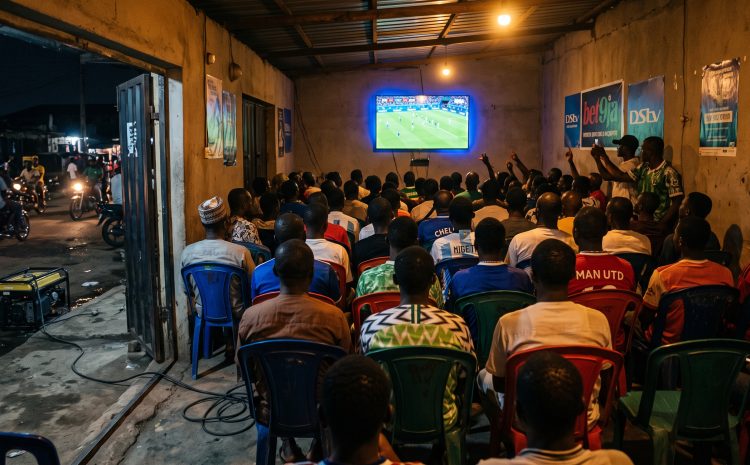
In February 2026, DStv subscribers turned on SuperSport for the Winter Olympics and found nothing there. For the first time in decades, the channel had not bought the rights.
Nobody in Johannesburg made that call. It was made in Paris.
Africa has never had trouble producing the audience. It has trouble owning the wire the audience is watched through.
The audience is already the asset.
Nairametrics puts Nigeria’s informal football economy at N5 trillion to N7 trillion a year, roughly $3.5 billion to $5 billion. It runs across more than 30,000 viewing centers, the Aba replica jersey trade, the Fantasy Premier League ecosystem, betting, and the mobile data underneath all of it.
The broadcast numbers say it in another currency. SuperSport’s World Cup run drew 19.1 billion social media views and 677 million video views from 817 videos on YouTube and TikTok, which carried 84% of them. It logged 54.4 million engagements, 10.1 million visits to SuperSport.com and 933,000 peak concurrent streams on DStv.
Of the 175,615 people who played its Predictor game and placed 3.81 million predictions, 21.2% were Nigerian, second only to South Africa at 29.5%.
The most discussed commentary track of the tournament was Pidgin.
Africa supplied the viewers, the culture and the language. It did not supply the rail.
The owner changed and nobody voted.
In September 2025, Canal+ completed its acquisition of MultiChoice for roughly $3 billion, handing a French group DStv and GOtv across more than 50 African markets. Since then the authority to bid for sports rights has moved from Johannesburg to Paris.
N313 billion a year of Nigerian money now flows to Canal+.
That is what the missing Winter Olympics was. Not a scheduling error. A decision taken 6,000 kilometers from the people who pay for it.
The fastest growing layer is not African either, and it is advertising.
Sub Saharan Africa is now the fastest growing streaming region on earth by revenue, climbing about 72% from $1.8 billion in 2026 to $3.1 billion by 2031.
The largest platform inside it is already YouTube, at $583 million of advertising revenue in 2026, more than any single subscription service earns in the region. By 2031, advertising revenue grows 103% to $1.3 billion while subscription revenue grows 59% to $1.6 billion.
This market was always advertising first, subscriptions layered on top for a smaller, wealthier slice. So the money sits in the ad slot and the payment rail, not the content library everyone is fighting over.
The gap is engineering, and somebody has already priced it.
68% of Africans use mobile money. Only 32% of streaming platforms accept it.
Operators who close that gap report conversion rising as much as 40%. Only 16% hold a revenue generating telco partnership, in a market where 1 telco deal can double an operator’s reach. Only about 33% call their own streaming infrastructure reliably stable.
The bottleneck is not talent and it is not appetite. It is a checkout button.
1 owner is trying to buy the rail back, and he is doing it with a listing.
Mr Eazi told Nairametrics he intends to list a technology company on the Nigerian Exchange, and wants Nigerians to own it. He has not named a date. He has named a direction, and behind it sits a decade of building the layer under the music.
emPawa Africa, the incubator that backed African artists before the majors would.
1v1 Africa, in sports.
Detty Rave, 8 years old, a live property that fills a venue without a label’s permission.
pawaPay, the payments company where he sits as investor and board member.
The exchange he is pointing at is not the exchange of 3 years ago. The NGX has gone from N30 trillion in 2023 to N160 trillion in 2026, up 430%, with N230 trillion projected by year end and Dangote’s $5 billion refinery listing due in October to prove it can absorb size.
An artist is proposing to answer an ownership question with a prospectus.
Who wins, who is squeezed, and the gap
The winners sell the plumbing. Mobile money at the checkout of every streaming service that still cannot take it. Server side ad insertion and local ad sales for a $1.3 billion advertising market growing twice as fast as subscriptions. Telco bundling, where 1 signature doubles a platform’s reach. And the 30,000 viewing centers, a distribution network nobody has bothered to license.
The squeezed are the artist who owns masters and nothing underneath them, the subscription only platform in an advertising first market, and the African broadcaster bidding against a group that decides in another time zone.
The gap is the till. The continent has spent 10 years building the content and almost none building the counter it is sold across, which is why 68% of the customers cannot pay with the money in their hands.
You do not have to own the league, the studio or the satellite to own the margin. You have to own the moment the viewer pays.
That is the conversation waiting at the Business Week Afrika Summit on 1 and 2 October 2026. The people who make the content, the people who move the payments and the people who own the distribution sit in 3 different rooms while the rights get priced in a 4th. The Summit puts the creator, the fintech operator, the telco and the exchange in 1 room, which is where an African rail gets designed instead of rented.
Secure your seat and join the builders closing the gap: https://apps.little.africa/events/105
In Aba tonight a generator will cough, 60 plastic chairs will fill, and a room will roar at a goal scored 5,000 kilometers away, on a signal that was bought, priced and settled somewhere none of them will ever see.