

Africa Processes 2% Of Its Own Cotton. The Plan To Fix That Buys Its Machines From Switzerland.
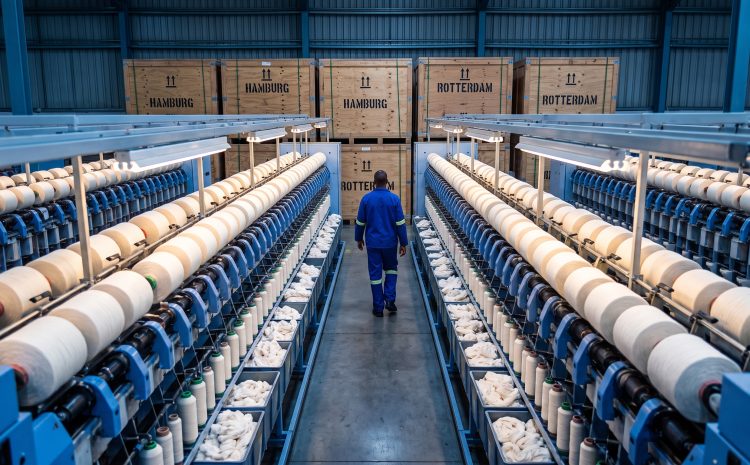
Africa grows less than 5% of the world’s cotton. It supplies about 15% of the raw cotton the world trades. And it processes 2% of what it grows.
Hold that 2%. Everything else in this story is that number moving, or refusing to.
The 2% is not an empty field.
The easy version of this story is that Africa does not process its own cotton, and a builder who believes that version will misread the opportunity completely.
Hawassa Industrial Park in Ethiopia is the largest textile industrial park on the continent, a $250 million build where 18 global apparel and textile companies operate alongside 6 local manufacturers. Textiles and garments are 85% of everything Ethiopia’s industrial parks produce. Fully loaded, Hawassa is designed for 60,000 workers and $1 billion of export revenue.
Tanzania runs 3 integrated mills. Sunflag carries the ring spinning and the yarn preparation. Textiles are more than 95% of everything Tanzania sells into the United States under AGOA.
The machinery of a cotton industry already exists here. It is staffed, it is exporting, and it has customers.
It is 2%.
The money showed up, and it showed up dated.
On 14 October 2024, Afreximbank, ARISE IIP and the Swiss spinning systems maker Rieter signed a framework agreement for the Africa Textile Renaissance Plan. The commitment is specific: 500,000 metric tons of African cotton transformation capacity inside 3 to 5 years, and 500,000 jobs, on $5 billion of financing.
The money behind the money is real too. Afreximbank’s investment arm FEDA put $300 million into ARISE IIP’s funding round that same month, and ARISE separately secured a $450 million Afreximbank facility for industrial parks and special economic zones.
Running alongside it is the Partnership for Cotton, whose target is written as the number itself: local processing from 2% to 25% by 2035, worth about $6 billion of value added product. Afreximbank is building cotton processing zones in Cameroon, Chad and Mali, with conversations live in Kenya, Rwanda and Nigeria. The initial focus is the C4+ group: Benin, Burkina Faso, Chad, Mali and Cote d’Ivoire.
2% to 25%. That is the entire plan, stated as arithmetic.
Now read the third signature.
Rieter is the world’s leading supplier of the systems that turn staple fiber into yarn. Rieter is in Winterthur, Switzerland.
So the $5 billion plan to keep Africa’s cotton jobs in Africa will spend a serious share of itself buying spinning machines from Europe, shipping them to Cameroon and Chad and Mali, and then paying Europe again for the spares, the retrofits and the engineers who commission them.
The crop moves from 2% processed to 25% processed. The equipment line stays at 0%.
That is not an argument against the plan. 500,000 jobs is 500,000 jobs, and a continent that waits for perfect sovereignty before it builds anything will wait forever. It is an argument about where the second business is.
It is the same shape everywhere you look.
Ethiopia has annual demand of roughly 265 million glass bottles and produces about 25% of them, against an import bill reported at around $170 million a year covering bottles, float glass and pharmaceutical packaging. The Development Bank of Ethiopia will fund 70% of a plant to close that gap. The sand, the limestone and the dolomite are already inside the country.
The pattern repeats across every beneficiation plan this publication has tracked. Gabon dating its ban on raw manganese exports. Ghana routing gold through GoldBod. Uganda turning gas into fertilizer. A 50kg micro ginnery in Kirinyaga. Every one of them has to buy the machine that does the converting from somewhere else.
There is exactly 1 firm in this archive that sells the machine rather than buying it, and it is Egyptian.
Who wins, who is squeezed, and the gap
The winners are the operators who get inside a named zone while the financing is still being deployed rather than after it has been spent, in Cameroon, Chad, Mali, Kenya, Rwanda or Nigeria. The aggregation layer between smallholder farms and mill gates, which is what decides whether a spinning line runs at capacity or at 40%. Grading, testing and certification, because a mill that cannot prove its fiber quality sells at the buyer’s price. And the service business, because 500,000 metric tons of new capacity is 500,000 metric tons of machines that will break, in countries with no service network.
The squeezed are the raw lint trader whose whole margin is the difference the zones are being built to erase, and the government that finances a processing zone and then imports 100% of what goes inside it.
The gap is the capital goods layer. Africa has started financing industrial capacity at continental scale and is buying every machine that capacity runs on. The service and retrofit business is the door that opens first, because it opens the day the equipment lands. The machine itself is the door behind it.
You do not have to build the spinning frame to be in the spinning business. You have to be there when it arrives.
That is the conversation waiting at the Business Week Afrika Summit on 1 and 2 October 2026. The financiers writing the $5 billion, the operators who will run the zones, and the engineers who could eventually build what those zones import have never been in the same room, which is why the equipment line keeps getting written in Swiss francs. The Summit puts them there.
Secure your seat and join the builders closing the gap: https://apps.little.africa/events/105
Somewhere in Winterthur a spinning frame is being crated for Chad, and the invoice taped to the side of it is written in a currency no cotton farmer on this continent will ever be paid in.