

Africa Won The Argument About Who Owns The Mines. It Never Built The Company That Runs One.
On 4 September a tender closes in the West Wollega zone of Ethiopia’s Oromia region. A gold project moving toward construction wants 200,000 liters of fuel storage, 4 tanks of 50,000 liters each, manufactured, transported and installed.
The tender went out on 20 August. That is a 15 day window.
Somebody will win it. This story is about who.
Africa has spent 3 years arguing over who should own its mines. That argument is finished. The one nobody has finished is who can run one.
Rewind 2 weeks.
On 21 August 2026 Niger’s cabinet met under General Abdourahamane Tiani and granted a large scale uranium mining license over the Arlit perimeter to Tsumco SA, a company the state created after nationalizing Somair. Before that, Somair belonged 63.4% to France’s Orano and 36.6% to the state holding Sopamin.
On paper, that is a completed act of sovereignty.
In practice, an arbitration tribunal at the World Bank’s ICSID has ordered Niger not to sell or transfer the stockpiled uranium while Orano’s claims are heard. Niamey has since offered to hand Orano back its 63.4% share and cover the freight. Orano’s Niger joint venture is reported to be close to bankruptcy.
Niger owns the mine. It cannot sell what the mine already produced.
Rewind several more months.
In mid January 2025 Mali blocked gold exports from Barrick’s Loulo Gounkoto complex, detained staff and seized 3 metric tons of bullion. Barrick pulled the asset out of its guidance. The complex went under provisional administration and reopened that July with a state appointed administrator in charge.
Then Mali did the thing Niger has not. It settled. A deal was struck at the end of 2025, and in February 2026 the license was renewed for 10 years, the operator back in the operator’s chair.
Watch what the ore did.
Loulo Gounkoto produced 22.5 metric tons in 2024. Under seizure and administration through 2025, it produced 5.5. In the first half of 2026 alone it produced 6.9.
Mali’s total industrial gold output rose about 30% to 23.5 metric tons in the first 6 months of this year, against a government forecast of 21.2, and the mines ministry now expects 43.2 for the full year. B2Gold’s Fekola led on 8.85 metric tons, Barrick’s Loulo followed at 6.9, Allied at 3.5, Resolute at 3.
2 governments, the same premise, 5 months apart, opposite results.
The variable was whether anybody in the room could operate the asset and sell what came out of it.
Back to West Wollega, Ethiopia
The project is Tulu Kapi, the Ethiopian subsidiary of London listed KEFI Gold and Copper. It is being built on a $240 million debt facility from the Eastern and Southern African Trade and Development Bank and the Africa Finance Corporation. Both are African institutions. The money came from the continent.
The biggest contract did not stay on it. The mining services agreement, worth more than $400 million, went to BCM Group. Commissioning is targeted for late 2027.
So the capital is African, the buyer is African, and the largest line item, the business of running the mine, was awarded somewhere else.
That is the gap, priced.
The same gap sits at the bottom of the ladder, and this month it surfaced in Kenya.
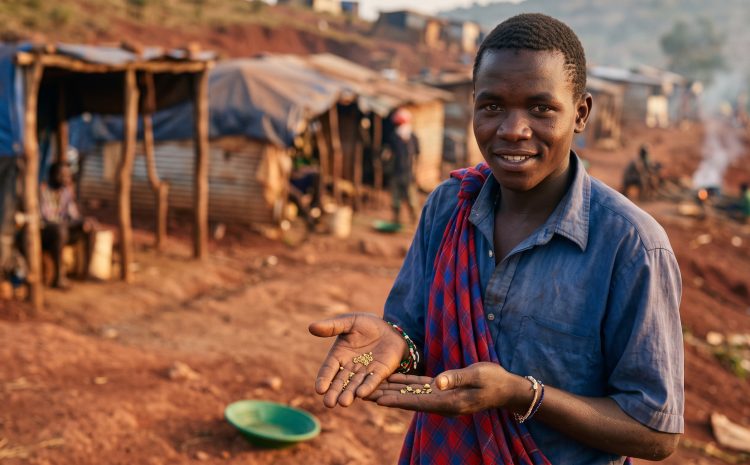
In Cheporor village, West Pokot, a 33 year old goat herder named Manasse Lomachar picked up 3 grams of gold and sold it for 36,000 shillings, roughly $280. Before that, women in the area panned alluvial gold for $8 to $23 a week.
About 10,000 prospectors came. Roughly 2,500 are still there. The better finds have run to around 78,000 shillings, close to $600.
Within weeks, more than 200 businesses had appeared to sell them food, water and supplies.
Read that again. A trading economy assembled itself around a gold rush in under a month. An assay service did not. A licensing desk did not. A buyer of record did not.
The state is pushing from the other side. Mining Cabinet Secretary Hassan Ali Joho suspended Tata Chemicals Magadi’s operations this month citing 3 breaches, the first of them having no mineral beneficiation strategy. Value addition has stopped being policy language. It is now a license condition.
Who wins, who is squeezed, and the gap
The winners are operating companies. Contract mining, earthworks, plant maintenance, assay and sampling, fuel and camp logistics, the technician who keeps a crusher turning. Each of those runs on a contract rather than a concession, so it needs nothing granted by a ministry and no $240 million from a development bank. It needs a crew and a track record.
The squeezed are the government that takes an asset it cannot operate, and the artisanal miner who finds the metal and has nowhere legitimate to sell it.
The gap is the operating layer, and it comes with a calendar. Tulu Kapi is tendering now. Mali is scaling toward 43.2 metric tons. Every beneficiation rule written on this continent creates another plant somebody has to run.
We have spent a long time here on owning the next step. This is the step underneath it: owning the crew that runs the step.
That is the conversation waiting at the Business Week Afrika Summit on 1 and 2 October 2026. The financiers writing the facilities, the ministries writing the license conditions, and the operators who could hold those service contracts have never been in one room, which is why the biggest line on an African mine keeps going to somebody who flew in. The Summit puts them there.
Secure your seat and join the builders closing the gap: https://apps.little.africa/events/105
4 steel tanks are waiting to be built for a hillside in West Wollega, and the only thing still undecided is which country’s welders get the drawing.