Africa’s power problem is usually told as a shortage of power plants.
In Cameroon, the plant is finished. The problem is 75 kilometers of cable.
The wire
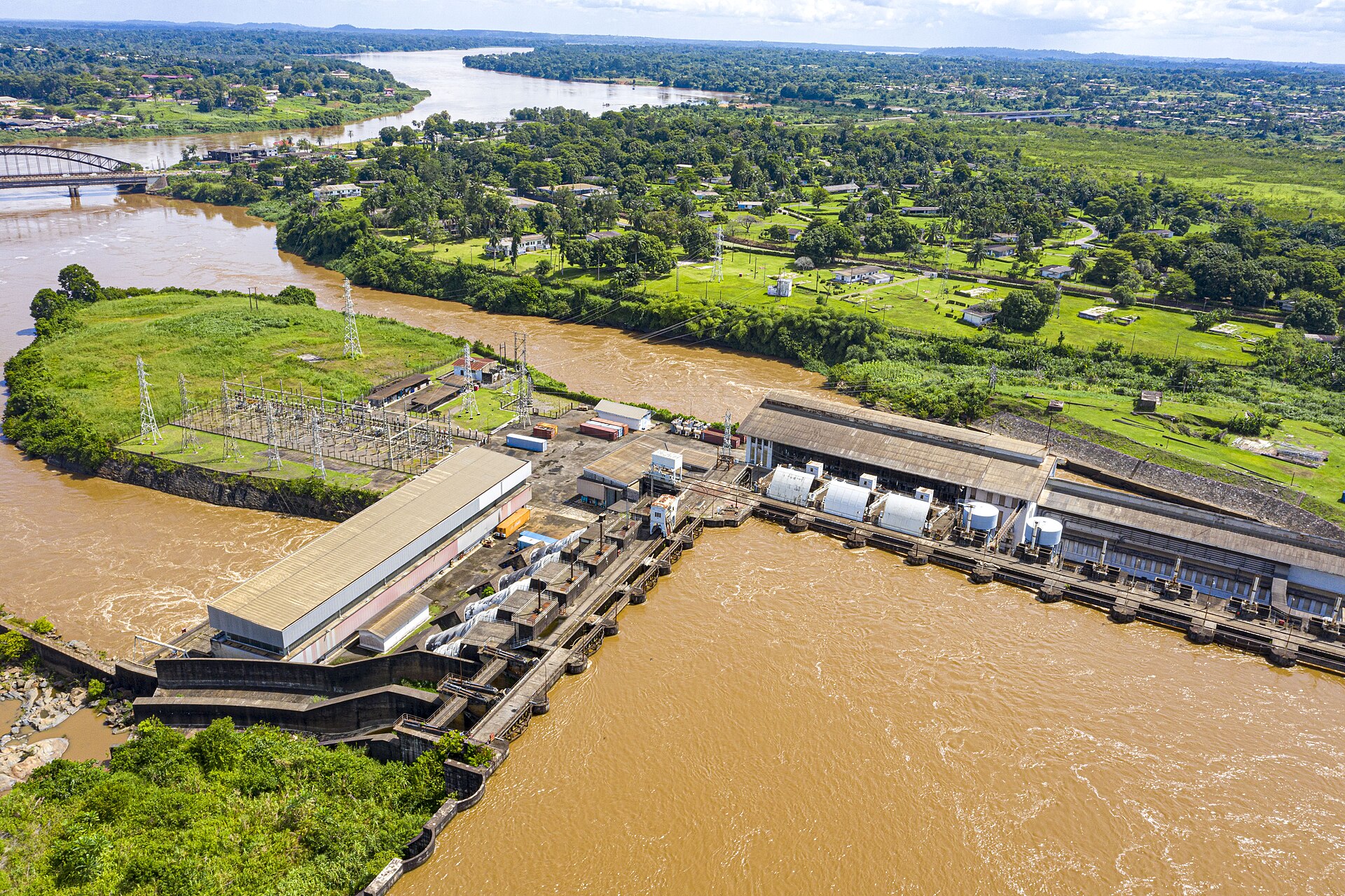
Nachtigal sits on the Sanaga River, northeast of Yaoundé. It cost about €1.2 billion, and its owners read like a roll call: EDF holds 40%, the IFC 20%, the Republic of Cameroon 15%, Africa50 15% and France’s STOA 10%. Its 7 turbines of 60 MW each have all been running since March 2025. Together they have made more than 4 terawatt hours of electricity.
Getting that power to Douala, the country’s industrial port, needs a 400 kV line from Nyom through Nkolkoumou to Edéa: 397 towers, built to carry up to 1,500 MW.
The government set June 2026 to switch it on. June passed. When Water and Energy Minister Gaston Eloundou Essomba inspected the works on October 7, contractors at Ebombè still had 5 towers to raise and 75 kilometers of cable to string. The substation at Edéa-Béon was 95% done, now due November 15.
“We cannot go beyond November.”
Gaston Eloundou Essomba, Minister of Water and Energy
Meanwhile, the ministry says, more than 150 MW of factory demand in Douala is waiting, worth nearly CFA4 billion a month in sales. The World Bank, which added $50 million to the transmission program in June, says that without the line the coast keeps burning costlier thermal power.
Cheap water at one end. Thermal plants at the other.
The buyer
The second thing a power plant needs is someone to pay for its power, every month, for years. In most African markets that someone is the state utility, and lenders want a government guarantee behind it.
Zambia found a workaround. Africa GreenCo is a licensed middleman: it signs to buy a plant’s output, then resells it to utilities and commercial customers, and across borders through the Southern African Power Pool. Zambia approved it as a creditworthy buyer standing between the independent producers and ZESCO, the state utility. If 1 customer defaults, GreenCo can sell the power to another.
Lenders understand that. A 13-year GreenCo contract carried the 100 MW Chisamba solar plant to $71.5 million of debt from Stanbic Bank Zambia, and it has been running since June 2025.
On October 8 in Lusaka, GreenCo signed for twice that: AXIAN Energy’s 200 MW Kudu solar project, about 530 gigawatt hours a year, all of it bought by GreenCo for resale across Southern Africa.
The buyer is no longer 1 utility. It is a region.
The border
The third piece is being drawn on a map between Zambia and the Congo.
The DRC’s power deficit tops 1 gigawatt, by the project promoters’ count, and it hits the copper mines of the southeast hardest. A 200 km line from Kalumbila in Zambia to Kolwezi would let the DRC import up to 550 MW. The $300 million project has a framework agreement: Gridworks leads the equity, Trafigura is arranging the debt, and the DRC’s strategic investment fund, FIS-RDC, and EnPower take stakes.
The power exists on one side of a border. The factories are on the other. The wire is the whole deal.
The lesson
Read the 3 together and a pattern shows. Generation is the part Africa has learned to finance. The money for Nachtigal came. The solar farms in Zambia came.
What stalls is in between: the line that carries the power and the buyer that can pay for it. Those are the parts with no glamour, no ribbon cutting, and the longest delays.
For a founder, that is where the scarcity is, and scarcity is where the margin lives. Zambia shows an intermediary that aggregates buyers can turn a solar farm into a bankable loan. The Kalumbila line shows a wire can be financed as a business of its own, if the crossing earns.
In Cameroon, the water is already falling. It is waiting for 75 kilometers of cable.