

David Made a Profit: How Takealot Held Its Ground Against 3 Goliaths
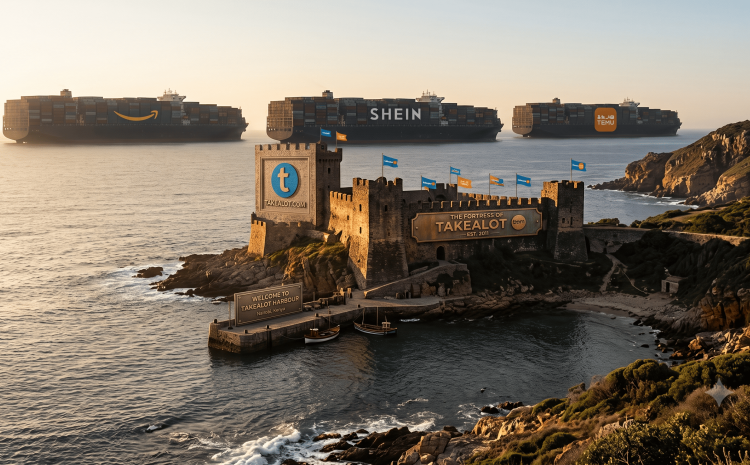
Amazon landed in South Africa in May 2024, the largest retailer on earth arriving in Takealot’s home market for the first time.
15 years in, staring down that arrival, Takealot did the one thing it had never managed in all 15.
It made a profit.
For the financial year to March 2026, Takealot Group posted its first full-year operating profit since it launched in 2011: roughly $11 million, or R180 million, swinging from a $13 million loss the year before.
Revenue crossed $1 billion (R17.3 billion) for the first time. Group merchandise value hit $2 billion (R34.6 billion). The year it was supposed to be flattened is the year it finally paid.
The lesson underneath the numbers is the one worth carrying.
The moat was never the price.
Amazon was supposed to be the end.
It has the deepest pockets in retail, a global logistics machine and infinite patience. But it arrived into a market where Takealot had spent 15 years laying warehouses, pickup points and last-mile routes across a country that is hard and expensive to deliver in. Amazon’s start has been slow, same-day in a few metros, pickup points trickling out. Takealot still commands around 31.9% of online shoppers to Amazon’s 12.3%. The giant has the ocean. The local player already owned the harbour.
The clever move.
Then came the ships from Shenzhen.
Shein and Temu flooded in on rock-bottom prices, together clearing an estimated R7.3 billion in 2024 and swallowing more than a third of the online clothing market.
On price alone, Takealot could not win that fight and did not try. 2 things saved it. South Africa closed the tax loophole, putting a 45% import duty and 15% VAT on all clothing parcels from July 2024, erasing the cheap-freight edge. And Takealot did the genuinely clever thing.
It hosted its own rivals.
Rather than bleed out competing on catalogue, Takealot opened its marketplace to international sellers, including the very Chinese merchants undercutting it, then made its money on the layer they all have to stand on: Takealot Fulfilment Solutions, the warehousing and delivery spine every seller needs to actually reach a South African doorstep.
Let the cheap goods come. Charge them rent on the road.
This is the same move Jumia is now running in West Africa, and it is why Naspers keeps using one word for what Takealot built: a moat.
That reframe reorders who wins and who is exposed.
The winners are the builders who own fulfilment and logistics infrastructure, not the ones chasing the lowest sticker.
Takealot proved that in the hardest possible conditions: an African market most people call too small and too cash to defend, held against 3 of the best-funded companies alive. The squeezed are the pure-price cross-border platforms once the regulatory loophole shut, and any local champion that assumed scale alone would save it.
The gap for the African entrepreneur is the road itself: warehousing, last-mile, returns, seller-fulfilment services, the unglamorous infrastructure every marketplace from Lagos to Nairobi still lacks. You do not need to win the race. You need to own the ground everyone races on.
This is the conversation the Business Week Afrika Summit is built to have. On the 1st and 2nd of October 2026, the operators building Africa’s fulfilment and marketplace layer meet the capital and the policymakers deciding whether the continent’s commerce runs on infrastructure owned here or rented from abroad. Takealot is the proof that a homegrown platform can hold the line, and then some. Come learn how the moat gets built.
Secure your seat and join the builders: https://apps.little.africa/events/105
Amazon has the ocean. Shein and Temu have the tide.
Takealot has the harbour, and in this market, the harbour is where the money gets unloaded.