

Africa’s Biggest Market Was Never on the Books. Now It Is Getting the Rails.
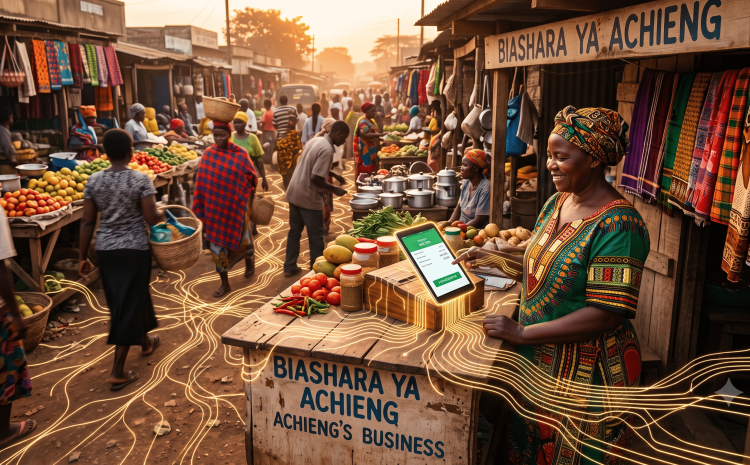
In Senegal, 98.6 out of every 100 jobs are informal. In Niger, 77.3. In Nigeria, N5.19 trillion sits outside the banking system altogether, 91.27% of the cash moving through the economy.
For a generation, the plan was to fix that from above. Formalize the trader. Bank the unbanked. Drag the corner shop onto the ledger. It rarely worked, because it asked the informal majority to abandon the thing that already works for them:
Cash, speed, no paperwork, no gatekeeper.
A new class of African builders has stopped asking. Instead of formalizing the informal economy, they are shipping its operating system, and quietly deciding who owns the rails underneath the biggest market on the continent.
Ovaloop is building the till.
The Nigerian startup, co-founded by Princewill Mba and Daniel Kilanko, calls itself the operational backbone for modern retail.
In practice it hands the corner shop a back office it never had: inventory, sales, payments, reporting and e-commerce in one place.
It already processes roughly N4.5 billion in transactions every month and is aiming at more than 100,000 retailers across Nigeria and beyond. The shopkeeper keeps the counter. Ovaloop takes a cut of everything that crosses it.
Kyosk is building the supply line.
Behind every one of those counters is a restocking problem: what to buy, from whom, on what credit, at what price. Kyosk now connects more than 200,000 informal retailers across Kenya, Nigeria, Uganda and Tanzania to suppliers, working capital and demand data. That 4-market footprint is the part that matters most. It is proof that a rail built under the informal duka is not a single-city trick. It travels.
Reemio and Uganda’s Wi-Fi resellers are building the trust layer.
The move is not only about retail.
In Nairobi, Reemio has listed roughly 28,000 verified rental units and made more than 150 placements in four months, stripping fraud and cost out of an informal housing market that ran on rumor and cash deposits.
In Uganda, informal Wi-Fi entrepreneurs earn 900,000 to 1 million shillings a month reselling internet access at 1,000 shillings a day into a base of 18.5 million subscribers, until the regulator arrives asking for a licence.
Different transaction, same instinct: put software under a handshake that used to have none.
The pattern is productization.
You do not drag the informal economy onto the books. You build the rails it already wants to run on, and you own them. Business Week Afrika has made this point before in other clothes: you do not need to own the shop to own the margin, you need to own the layer the shop runs on. The corner store stays a corner store. The value moves to whoever built the till, the supply line and the trust behind it.
That reframe reorders who wins and who is exposed.
The winners are the builders who ship the operating layer, and the operators who plug into it without giving up what works. The squeezed are the banks and formal chains that spent years believing the informal majority was too small, too scattered or too cash to catch, and the top-down formalization programmes now being outbuilt from below. The regulators are a step behind, chasing the Wi-Fi reseller for a licence while the real shift, ownership of the rails, happens somewhere they are not looking.
And the gap is enormous. Every informal vertical still running on memory and cash is an unbuilt operating system: boda and matatu transport, agri-inputs, water and waste, home services, cross-border small trade. Ovaloop is the retail proof. The next 10 Ovaloops are hiding inside the 98.6% no one has built for yet.
This is exactly the room the Business Week Afrika Summit exists to convene. On the 1st and 2nd of October 2026, the founders shipping these rails sit with the capital, the operators and the policymakers who decide whether the informal majority gets an operating system built by Africans or imported over their heads. The informal economy is not a side conversation at this Summit. It is the market.
Secure your seat and join the builders wiring it: https://apps.little.africa/events/105
The counter has always been there, crowded and cash in hand.
The till behind it is still empty. Will you be the one who builds it?