

Kenya Power Added 412,249 Customers And Earned Less while Africa’s Solar Sellers Are Selling Their Customers’ Repayments.
Kenya Power connected 412,249 new customers in a year and earned Sh1.07 billion less from them than it earned from the previous year’s new customers.
They used 20% less electricity. Sh5.12 billion became Sh4.05 billion.
In the same week, a Nairobi company that sells solar pumps on credit sold the repayments of its farmers to a fund in Paris for $10 million.
1 of those 2 businesses is selling power. The other has figured out what it is actually selling.
The receivable is the product.
The grid is winning customers and losing the bill.
The utility’s top line is fine, up Sh18.9 billion to Sh238.24 billion across 10.4 million customers. The problem is the newest cohort. 184,907 of the new connections came through the Last Mile Connectivity Project, households that switch on a bulb and little else. The commercial customers that should carry the load are going behind their own meter: 630 megawatts of captive solar now sits on Kenyan roofs and factory sheds.
Kenya Power MD Joseph Siror is adding connections faster than he is adding consumption.
A connection is not a customer. A customer is someone who pays you every month for years.
The companies that understood this are the ones that never built a grid.
The receivable is the product.
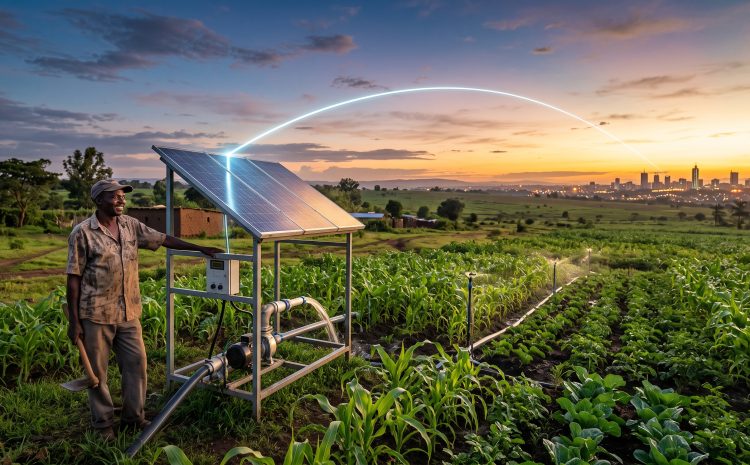
SunCulture has sold more than 85,000 solar irrigation systems since 2012 on what it calls Pay-As-You-Grow: the farmer takes the pump, the insurance and the warranty, and pays in installments out of the harvest the pump produces.
Each of those installments is a small, predictable loan repayment. On 24 September SunCulture stopped waiting for them.
A dedicated special purpose vehicle bought the receivables originated by SunCulture Kenya. The Mirova Gigaton Fund, a $282 million climate fund run from Paris, lent that vehicle $10 million on a senior secured basis. The cash goes back to SunCulture, which sells the next pump with it.
The company did not raise equity. It sold its future.
Look at who did what. The fund is French. The vehicle sits in Mauritius, on the ki Platform PCC run by Kaleidofin, a fintech from India. Kaleidofin picked which Kenyan farmers’ repayments were good enough to go in, using a credit model built on more than 30 million data points, and it now monitors the portfolio, reports on it and polices its covenants.
The farmers are Kenyan. The pumps are Kenyan. Every seat that decides what a Kenyan repayment is worth is held from somewhere else.
The receivable is the product.
Sun King already proved the local version.
In 2025 Sun King closed a KES 20.1 billion securitization, $156 million, backed by the future repayments of its Kenyan customers and funded by ABSA, Citi, the Co-operative Bank of Kenya, KCB and Stanbic. It was the company’s 2nd shilling deal and it finances about 1.4 million solar products and smartphones.
Kenyan banks will buy a Kenyan loan book, in shillings, when someone has made it legible.
This week Sun King took $5 million of equity from Acumen for Zambia, where it has delivered 1 million kits since 2021. The stated purpose is not the kits. It is to attract local-currency financing.
The equity is the key that unlocks the debt.
Who wins, who is squeezed, and the gap
Who wins: the pay-as-you-go company that can prove its book. SunCulture, Sun King and every seller of phones, motorcycles, cookstoves and pumps on credit who can show a lender clean repayment data now has a way to recycle capital instead of raising it round after round.
Who is squeezed: the model that sells a connection and hopes for consumption. And the mid-sized credit seller with 5,000 customers and a spreadsheet, too small for a Citi-arranged deal and too messy for a Paris fund.
The gap is the plumbing between a repayment and a lender.
The monitoring agent. The job Kaleidofin is doing in Nairobi from India: selecting receivables, modeling cash flows, reporting performance, watching covenants. No African firm is named in that seat on either deal.
The data room. A pay-as-you-go book is only fundable once its repayment history is cleaned, standardized and auditable. That is software a founder ships in a quarter.
The pooling arranger. 10 small credit sellers with 5,000 customers each is a 50,000-loan book, the size a bank will look at. Someone has to aggregate them, service them and stand behind the numbers.
And the insurance inside the loan. Turaco already reaches 8 million people across 6 African markets by embedding cover through M-KOPA and Safaricom. A receivable with its default risk insured is a receivable that prices cheaper.
The pump was never the business. The payment history is.
That is the conversation the Business Week Afrika Summit exists for. On the 1st and 2nd of October 2026 in Nairobi, 3 days from now, the operators who sell assets on credit, the banks that fund their books and the builders of the rails between them meet in 1 room. If you can make an African repayment legible to a lender, that room is your market.
Secure your seat and join the builders: https://apps.little.africa/events/105
Somewhere in Meru a farmer walks to her pump before sunrise, and her next installment is already on a spreadsheet in Paris.