

The Battery Is Solved. Nobody Is Selling The Repair.
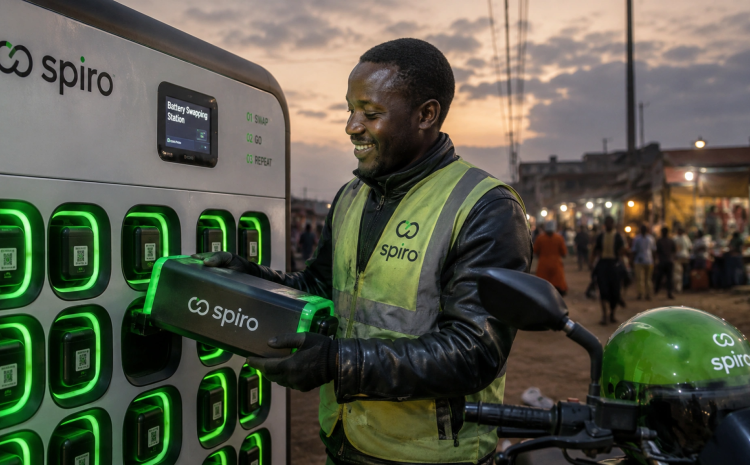
Last month a company from Bangalore opened 35 battery swap stations in Kenya. 27 in Nairobi, 8 in Mombasa, 20 of them on Shell forecourts. A rider pulls in, trades a flat battery for a charged one, and is gone in about 2 minutes.
Sun Mobility says that is the start. Over 5 years it plans more than 2,500 stations and more than 160,000 vehicles across Africa, riding on a partner, Vivo Energy, that already runs over 4,200 Shell and Engen sites in 29 African countries.
“Kenya is the beginning.”
AJAY Goel, co-founder and chief executive for international business
In the same city, the business that will fix an electric motorcycle no matter who built it runs out of 1 workshop in Westlands.
That is the whole story.
Nobody is selling the repair.
Look at who just arrived.
10 manufacturers have confirmed they are entering Kenya behind that swap network.
- Afrina Neopower, from China.
- QJ-YY, from China.
- Sprocomm, from China.
- VMoto, from China.
- Wylex, from China.
- BGauss, from India.
- Motovolt, from India.
- Odysse, from India.
- Piaggio, from Italy.
- Fika Mobility, from Kenya.
10 brands is 10 parts catalogs, 10 warranty regimes, 10 diagnostic systems and 10 sets of proprietary firmware, landing into a market that has 39,324 electric vehicles on its roads and about 2.5 million registered boda bodas, 1.8 million of them working today.
All of them solved the same problem. None of them solved the next one.
Nobody is selling the repair.
Read the rider’s day, not the launch photos.
Downtime is not an inconvenience in this business. It is the business.
An electric boda in Kenya costs between KES 180,000 and KES 350,000, usually financed. M-KOPA has put 10,000 of them on the road and puts the rider’s saving at Sh530 a day. Ampersand, running over 6,000 bikes and 8,000 batteries across Rwanda and Kenya, charges about $1.60 a swap, reckons the bikes cost 45% less to operate than petrol, and saves a rider roughly $700 a year. It handles more than 20,000 swaps a day across more than 900,000 kilometers.
Those margins are real and they are thin. A rider who loses 3 days to a controller fault has lost the month’s advantage. The financier behind that rider has lost 3 days of repayment on an asset that only pays while it moves.
So the industry built the fastest possible answer to an empty battery, and left the rider with a dead motor to find a mechanic who has never opened one.
Nobody is selling the repair.
Now count the technicians
Nigeria has a few certified electric vehicle technicians. Its population is more than 200 million.
High voltage battery servicing skills on this continent sit concentrated in Johannesburg and Cairo, which strands every asset inland. Authorized service centers cluster in capital cities. Everywhere else the work falls to informal workshops without genuine parts or high voltage training, on components that carry import tariffs and shipping delays before they carry a markup. The International Labour Organization has warned of a continental shortfall of electric vehicle technicians. Ghana’s own regulators now describe the same gap as a youth employment opportunity, which is the polite way of saying nobody has taken it.
Who wins, who is squeezed, and the gap
The winner is the multi brand depot. Not a dealership, which serves 1 badge: an independent service network that can diagnose a Wylex on Monday and a Motovolt on Tuesday, holds the parts for both, and sells a fleet financier a contracted uptime percentage instead of a repair bill. Behind it sit the parts importer, the diagnostic tooling business, the warranty administrator and the technical college that certifies the people, because the labor does not exist yet and somebody has to make it.
Note who is already halfway there. Carol Ofafa built E-Safiri in Kisumu on solar swap hubs, took it from 4 sites to 8, and engineered an optoelectronic concentrator with Glasgow Caledonian University that cuts the capital cost of a station by more than half. She did it on a grant of EUR 225,129. The African who made the hardware cheaper has 8 stations. The entrant with a fuel retailer behind it opened 35 in a month.
The squeezed are the riders who buy an orphan brand and discover in year 2 that nobody within 100 kilometers can open it. Also the lenders, M-KOPA and everyone financing these bikes, whose collateral quietly degrades when it cannot be serviced. And the single brand service model itself, which cannot work at 10 brands and 1.8 million machines.
The gap is not charging. Charging has 5 companies fighting over it.
The Business Week Afrika Summit on 1 and 2 October 2026 is where that argument gets settled in person: the financiers writing the asset loans, the operators running the fleets, and the builders who intend to own the layer underneath both. The swap station has its owners already.
The depot does not, and that is the last unclaimed position in African electric mobility. Secure your seat and join the builders taking it: https://apps.little.africa/events/105
Somewhere in Nairobi tonight a rider is standing beside a bike that will not start, outside a shop that only sells batteries.