

A Chinese Couple Built Africa’s Biggest Nappy Company, And East Africa Is Now Half Its Revenue.
In Kigali, a man called Beresheba Hakizayezu makes 100 pairs of shoes a month.
He buys his leather at Rwf1,800 to Rwf2,000 for every 30 square centimeters, in a country where that same leather could be produced for Rwf800 to Rwf1,200.
The 2 machines that would close that gap are a cutting machine at Rwf9 million and a skiving machine at Rwf3 million. About $8,300. They are not in the room.
What the headline said, and what is actually true
Last week a story ran across East African business pages: Softcare Kenya grew its revenue 17.4% to Sh7.2 billion. It was filed as a Kenyan success.
Here is what is actually true.
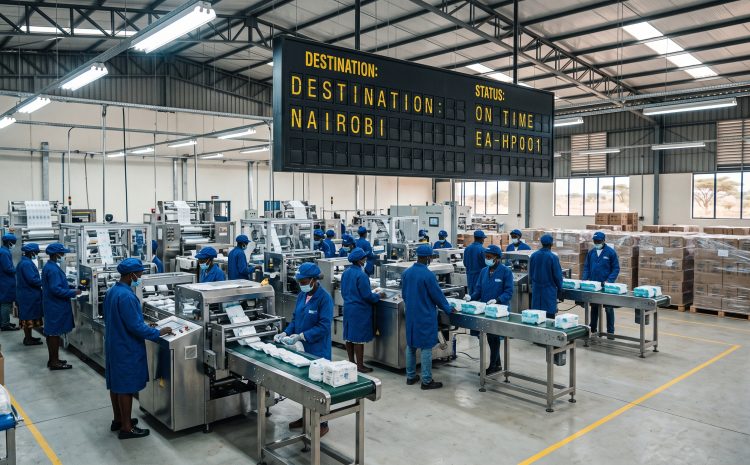
Softcare was founded by Shen Yanchang and Yang Yanjuan, 2 married classmates from Harbin Engineering University, after Shen moved to Nigeria in 1997. It began manufacturing on this continent in Ghana in 2018. On 10 November 2025 it listed in Hong Kong, rose 33% on the first day, and is now valued above $2.57 billion.
“Softcare Kenya” is a subsidiary.
In the first half of 2026 the group turned over $332.7 million, up 30.7%, and made $75.8 million of profit, up 46%, a net margin of 22.8%. East Africa contributed $151.4 million of it, which is 45.5% of everything the company earns anywhere on earth. Kenya alone is close to 19% of global revenue, employs about 1,500 people directly, and has another Sh698 million of expansion going in.
The product is a nappy that sells from 8.3 cents and a sanitary pad that sells from 4.72 cents.
The dullest thing in the shop earns 22.8%, and it books in Hong Kong.
The machines are arriving. The ownership is not.
Gokaldas Exports sews for Walmart, Gap, JCPenney, H&M, Primark and Nike, roughly 90 million garments a year. It is Indian. It is now moving production lines into Kenya and Ethiopia, because Africa carries a 10% tariff baseline while India carries a 50% US reciprocal duty, and because its own clients asked it to source from here.
The buyers wanted African-made goods and went looking for an Indian company to make them.
Indorama runs the petrochemical complex at Eleme, and 10.3 million tonnes of its 33.8 million tonnes of global output is already African. It has just announced 3 more projects: a gas terminal starting in the fourth quarter of 2026, a cracker and polymer expansion in 2027, and a 1.75 million tonne methanol plant, aiming to become the world’s 3rd largest fertilizer producer by 2030 in a market going from $9.9 billion to $15 billion.
Its managing director explained the strategy.
“Nigeria should be a hydrocarbon powerhouse for its industrialisation, not just its exports.”
MANISH Mundra
That is our argument, word for word. It is being made on our soil by a company headquartered somewhere else.
The world settled this 19 years ago, in the price
We keep arguing about whether Africa should own the next step. The market stopped arguing long ago.
Between 2005 and 2024, global trade in finished leather grew from $57 billion to $99 billion. Over the same 19 years, trade in raw hides and skins fell from $6.2 billion to $3.3 billion, and semi processed leather collapsed from $22 billion to $12.4 billion.
The world is paying more every year for the finished thing and less every year for the raw thing.
East Africa holds 4% of the planet’s cattle and 6% of its small ruminants, and exports under 1% of the world’s leather. It ships $33 million of raw hides out and buys $49 million of leather back.
Who wins, who is squeezed, and the gap
Whoever owns a line wins. Not a brand, not a distributorship, a production line. Softcare has proved the margin exists at the very bottom of the market, in a category where nappies are still Kenya’s highest volume import inside a hygiene market worth more than $600 million and heading for $5.6 billion across Africa by 2029.
Squeezed are the importers who only move other people’s boxes, and every African owner who spent 10 years building distribution for a product somebody else manufactures.
The gap is 2 things.
The first is contract and private label manufacturing into the unsexy categories, where the incumbent is foreign, the margin is 22.8% and the customer is already buying.
The second is equipment finance. A tannery park in the region is projected to turn over $430 million a year. The named export lanes sitting untouched are worth $298 million in apparel into South Africa and $17 million in leather into Uganda. And the thing standing between Beresheba and that market is not $8.3 million of capital.
It is $8,300 of machines that no lender on his street will price.
This is the conversation waiting at the Business Week Afrika Summit on 1 and 2 October 2026. The manufacturers, the equipment financiers, the development lenders and the export agencies each hold 1 piece of this, and they are not in the same room, which is exactly why the margin keeps leaving on a plane.
Secure your seat and join the builders closing the gap: https://apps.little.africa/events/105
In Kigali the bench is swept, the leather is cut by hand, and the space where the machine should stand is clean and empty and exactly the right size.