

Africa Can Ship To The World And Cannot Ship To Itself
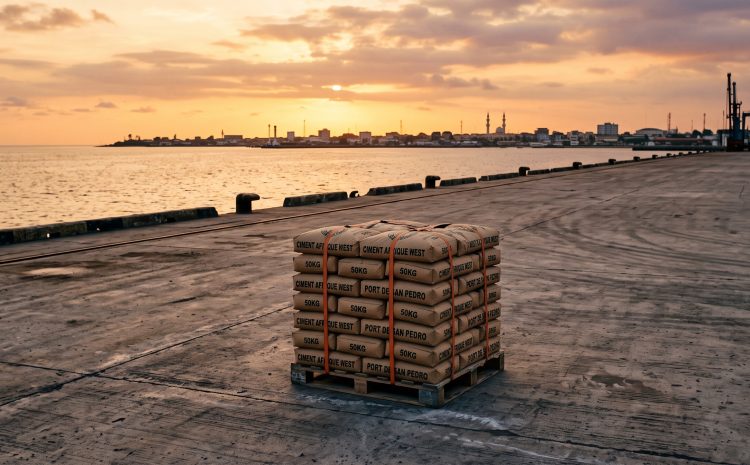
Africa’s richest man needed to move 1,000 tonnes of cement from Lagos to Accra.
He could not find a boat.
Not a cheap boat. Any boat. Dangote Industries went looking for a vessel to carry 1,000 metric tonnes to a country on the same coastline, roughly 2 days of sailing away, and came back empty. The road alternative runs through Benin and Togo, and every border takes its cut. So the company has concluded plans to buy its own fleet.
“Owning ships gives us control over the movement of our products.”
SADA Ladan-Baki, head of international trade and export at Dangote Cement.
The same group’s $20 billion Lagos refinery expects 600 vessels a year, in a country whose seaborne fuel exports have grown 7 times over since 2023.
The ramp out of Africa works beautifully. The road between African countries barely exists.
The export ramp is not the problem
Look at what Africa has built this decade. Deep-water terminals. Refineries. Rail concessions running to the Atlantic. This week the DRC signed a 30 year, $1.258 billion concession over 1,004.5 kilometers of the Dilolo to Sakania line, the Congolese leg of the Lobito corridor.
Every one of those assets points outward.
Ask any of them to carry 1,000 tonnes to the next country over and the system stops working. That is the business nobody is building?
Nairobi is being offered the one thing it does not need
Kenya Airways lost 16.08 billion shillings in the first half of 2026, up from 12.15 billion a year earlier, on revenue that actually rose 9.1% to 81.25 billion. Fuel alone rose 72% on the Gulf war, to roughly half of everything the airline spends.
Now an investor has offered Kenya Airways aircraft in exchange for equity. 4 firms from the United States, China, South Africa and Singapore are circling, with 131 billion shillings of government and bank debt on the table for conversion.
Read that again.
The airline is being offered planes. Meanwhile 3 of its 9 Boeing 787-8 Dreamliners sit grounded because nobody within reach can overhaul a GEnx-1B70 engine.
Kenya Airways wants to go from about 32 active aircraft to 100 by 2035, and cannot keep the ones it owns in the air.
“The constraint was not a shortage of customers.”
GEORGE Kamal, acting group managing director.
He is right, and that is the whole story. The demand is there. The asset is there. The layer that keeps the asset earning is not.
Somebody already built it, and they sell it to Emirates
Africa’s aviation maintenance market is worth $1.54 billion, heading toward $5.76 billion by 2035. Most African carriers still fly their aircraft to Europe, the Middle East or Asia for heavy maintenance. Only 4 on the continent run serious facilities of their own.
One of them turned it into an export business.
Ethiopian MRO has put $150 million into its complex at Bole: a widebody hangar, a component maintenance center, an automated parts warehouse, 50% more airframe capacity. It runs over 3,000 technical staff, graduated 235 technicians last year, and holds Ethiopian, American and European certification.
And it sells that work to Emirates, Qatar Airways, Saudia, FlyDubai, EgyptAir, Oman Air, Arik Air and LAM Mozambique.
Addis is fixing the Gulf’s planes while Nairobi grounds its own.
The treaty nobody signed
The Single African Air Transport Market has 38 participating states carrying more than 89% of intra-African air traffic. Only 23 of them have signed the memorandum that actually implements it. Full implementation would lift intra-African traffic by between 51% and 141% and cut fares by up to 35%.
Rwanda has stopped waiting.
“Even if Rwanda is to do it unilaterally, we will do it unilaterally.”
ANTOINE Marie Kajangwe, Minister of Trade and Industry.
At the very end of the journey, Lagos airport’s official rank charges 55,000 to 70,000 naira to reach Lekki Phase 2, against roughly 8,000 naira on a ride-hailing app.
The last 20 kilometers cost 7 times the market rate. So does the first 1,000.
What this opens
Who wins. The operator who sells movement between African countries as a product: short sea coastal freight, engine and component overhaul, parts pooling, certified technician training. Each has a named, paying, desperate buyer today. Dangote is buying a fleet because it could not rent a service. Kenya Airways grounds Dreamliners because it could not buy a repair.
Who is squeezed. Anyone whose margin depends on a border staying expensive. The airport monopoly rank. The transit state charging cement to cross. The foreign hangar billing African carriers in euros.
The gap. Africa spent a decade financing assets and never financed the layer that keeps them earning. We wrote about this when Moove found the depot and the technician scarcer than the vehicle. Same gap, one extra zero, sitting under a $1.54 billion market with 4 competent operators on an entire continent.
That gap is what the Business Week Afrika Summit exists to close. On the 1st and 2nd of October 2026, the people who own the assets and the people who could keep them earning will be in the same room in Nairobi, which is the one logistics problem on this continent we can solve in an afternoon. Secure your seat and join the builders: https://apps.little.africa/events/105
1,000 tonnes of cement, sitting on a Lagos dock, 2 days of open water from a customer who wants it.