

African Pension Funds Hold 775 Billion Dollars. A Manila Billionaire Just Bought The Ports They Owned.
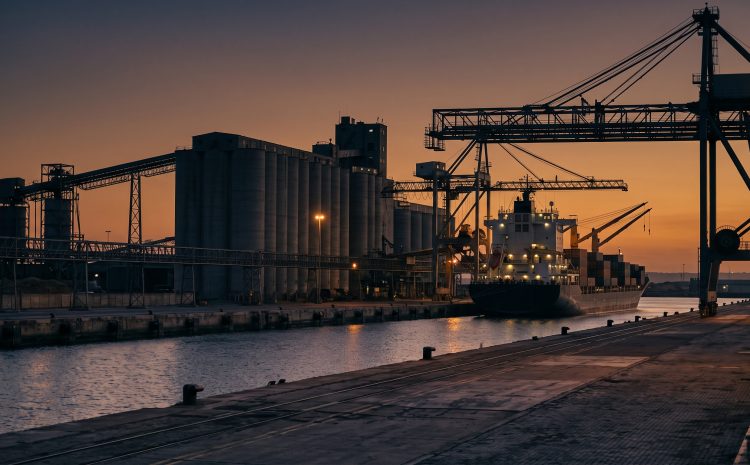
On 28 August, a Manila billionaire agreed to buy the ports.
Not build them. Buy them, finished, from the people who already owned them.
International Container Terminal Services signed a sale and purchase agreement for 100% of TLG, The Logistics Group, which runs port and cargo handling facilities across Mozambique, Namibia and South Africa in bulk commodities and agricultural cargo. Enrique Razon Jr. holds 51% of ICTSI. Forbes valued him at $21.8 billion in August, up from $11.5 billion a year earlier.
The standard reading is foreign investment arriving in African infrastructure.
Read the seller instead.
Who was on the other side of the table?
African Infrastructure Investment Managers, the infrastructure arm wholly owned by Old Mutual Alternative Investments since it bought out Macquarie’s half in November 2015, holding 74%.
The IDEAS Managed Fund, founded in 1999, roughly R13 billion, rand denominated, structured as a policy on Old Mutual’s balance sheet so that pension funds receive the tax treatment.
African Infrastructure Investment Fund 4, the pan African vehicle alongside it.
The Mokobela Shataki Consortium, holding the remaining 26%, sponsored by Moss Ngoasheng of Safika Holdings and Monhla Hlahla, former chief executive of Airports Company South Africa.
AIIM bought the same asset on 31 March 2022. Neither the 2022 price nor the 2026 price has been disclosed, so nobody outside the deal knows what the round trip returned.
Now hold that against a mine.
3 days earlier, the domestic bid showed up.
On 25 August, Northam Platinum told the market it had received an unsolicited, exploratory and non binding approach from an unnamed major producer in the South African platinum group metals industry. Northam is worth roughly R122 billion. It produces about 940,000 ounces of platinum group metals and 1.7 million tonnes of chrome from Zondereinde, Booysendal and Eland.
It did not negotiate quietly. It opened a competitive process and invited further proposals. The shares rose 11% intraday.
The bidder is unnamed in the announcement. The 3 producers the market considers credible are Valterra, Impala and Sibanye-Stillwater.
All 3 are South African.
The reason is not that the money is missing.
African pension funds and insurers hold roughly $775 billion, $455 billion in pensions and $320 billion in insurance, according to the Africa Finance Corporation’s State of Africa’s Infrastructure Report 2025. Count sovereign wealth funds and the pool reaches $2.1 trillion. In some countries, 70% to 80% of institutional portfolios sit in government debt.
The rules are not the obstacle either.
Nigeria’s regulator permits pension funds to put up to 15% of assets into private equity, against an industry holding ₦31 trillion. Ghana’s regulator allows up to 25% in private funds. Ghanaian pension funds actually allocate 0.58%.
What is actually in the way, and is it buildable?
Gedeon Baleke, Secretary General of the African Coalition for Development, names 3 things, and none of them is a rule.
Trustee boards do not have the in house expertise to appraise an infrastructure transaction. A government bond that underperforms is explained as market conditions; a private placement that underperforms is a named trustee’s personal reputational risk. And when African capital does reach private assets, it is usually domiciled through Mauritius, Luxembourg or Delaware, so the expertise accumulates offshore and never compounds at home.
Then there is the memory. Ghana’s December 2022 domestic debt exchange touched 95% of pension fund holdings, and bondholders took losses of 60% to 70%. A trustee who lived through that prices sovereign paper as safe and everything else as career risk, which is precisely backwards, and entirely rational.
This is the same shape this platform keeps arriving at: the asset exists, the capital exists, and the profession that would connect them does not.
Who wins, who is squeezed, and the gap
Winning right now is the operator with a balance sheet, a deployment mandate and no committee to convince. ICTSI gets 3 African markets in 1 signature.
Squeezed is the African fund manager who cannot raise at home and so raises abroad on foreign terms, and the founder whose realistic exit is a stranger because no domestic bid was ever built.
The gap is a services business, not a fund.
Independent infrastructure due diligence and credit analysis, sold to pension boards as a paid engagement, so a trustee can defend a decision with something other than instinct. Trustee capability and certification, because the boards are the bottleneck and nobody is paid to fix them. And onshore fund administration, legal and audit, so a Lagos or Nairobi fund does not have to route through Port Louis to be taken seriously.
Aid is not going to cover the difference. OECD aid fell 23.1% in 2025 to $174.3 billion, bilateral aid to sub-Saharan Africa fell 26.3%, and a further 11.6% decline is projected for 2026.
The $775 billion is already home. It is just not being asked to do anything.
That question, who is allowed to own the thing Africa builds, is the argument the Business Week Afrika Summit exists to hold in 1 room. On 1 and 2 October 2026, the people who allocate the continent’s institutional money sit with the people building the assets it could go into, a conversation that never quite happens because the 2 groups keep meeting separately and calling it a market.
Secure your seat and join the builders working out who owns the next asset before it is sold: https://apps.little.africa/events/105
Somewhere in Johannesburg there is a trustee with a mandate that permits 25%, a portfolio that shows 0.58%, and a quarterly meeting on Monday.