

Talent Was Never the Gap: The Week Africa Built the Machine Under Its Creators
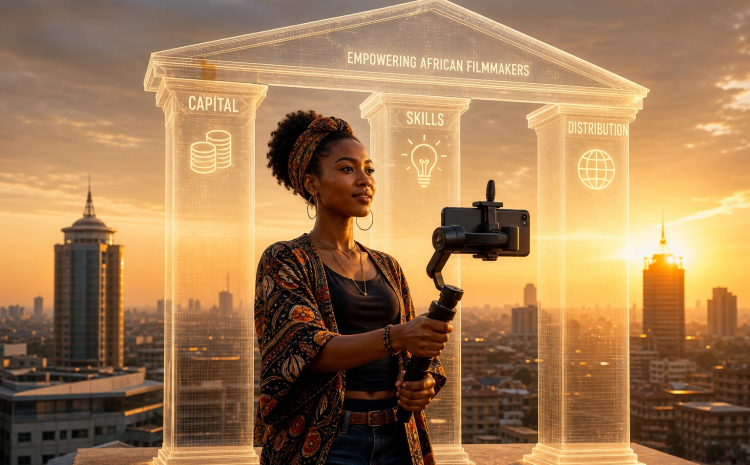
“Give me a phone, a camera, and an audience, and I will build you a business.”
That is the promise every young African creator has made for a decade. The talent showed up. The audience showed up. What never showed up was the machine underneath:
The money to scale, the skills to sharpen, the pipes to reach the room.
This week, in the space of a few days, all three arrived at once.
Start with the money.
Nigeria’s Bank of Industry handed Kuramo Capital a $170.6 million iDICE Fund of Funds built for one thing: financing digital and creative enterprises.
It is $85.3 million of government anchor capital matched by $85.3 million Kuramo must raise privately, with the government swallowing a 30% first-loss tranche so private money comes in braver. The fund targets a 20% net return and a 2.4x multiple, carries another $110 million in debt behind it, and can write up to $100,000 into a single growth-stage startup. It already counts 185 founders and creative hubs across 66 campuses.
Read that slowly. This is not a grant scheme. It is a creative economy being handed a real balance sheet.
Then the skills.
Google, alongside Idris Elba, put $1 million toward expanding AI access for 100,000 African creators. Not laptops, not hashtags. The tooling that decides whether one person with a story can now do the work that used to need a crew of 10.
Then the distribution.
Squarehouse TV launched as a lean, YouTube-native studio that refuses to wait for the old gatekeepers, sourcing stories pan-Nigerian rather than Lagos-only, shipping its debut film Nwa Boi direct to an audience of 153 million Nigerians already online. Its founders put the thesis plainly:
“Great storytelling and a scalable business aren’t mutually exclusive.”
Capital, skills, distribution.
The 3 things every real industry needs, delivered to the creative economy in a single week, all pointed at a continental prize the sector is on track to reach: $200 billion by 2030.
Here is the reframe the headlines miss.
Africa never lacked creators. It lacked the stack under them. For years the talent carried the whole weight alone, monetizing through borrowed foreign platforms that kept the margin, the rights, and the data. What landed this week is not more talent. It is the plumbing.
Who wins, who is squeezed, where a builder leans in.
The winners are the ones who build the machine, not just perform on it. The fund manager who can actually price a creative SME. The studio operator running the lean Squarehouse model in Nairobi, Accra, or Kampala. The platform that handles a creator’s payments, rights, and royalties so the margin stays home.
Squeezed are the legacy broadcasters and studios carrying high fixed cost and gatekept distribution, and the intermediaries who lived on the toll between a creator and their audience.
The gap to build into is the whole missing middle of the creative economy: the financing rail for creative enterprises too big for a grant and too “unbankable” for a bank, the direct-to-consumer distribution and monetisation layer, and the rights tooling that turns a viral moment into an asset you own.
This is a previous lesson widened. Oga Obinna owned the attention conversion layer for one show. The instinct now scales to an industry:
Own the infrastructure under the talent, not just the talent.
De-risked capital, sharpened skills, and owned distribution do not assemble themselves. They need the people who build funds, studios, and platforms in the same room, comparing notes. That room is the Business Week Afrika Summit on 1 and 2 October 2026: the fund managers pricing creative risk, the studio operators proving the lean model, and the platform builders keeping African margin on African soil.
Secure your seat and join the builders assembling the stack: https://apps.little.africa/events/105
Africa has always had the story. This week it started building the machine that pays for the telling.