

The Dollar Takes Two Cuts on Every African Payment. This Week, Africa Moved to Stop Paying It.
You run a small importer in Lagos. Your supplier sits in Accra.
She invoices you in Cedis. You hold Naira. And to move money the 400 kilometers between you, your payment leaves the continent: Naira becomes Dollars somewhere in New York, Dollars become Cedis, and a fee is skimmed at each turn.
Two conversions. Two spreads.
On a transaction between two African cities that never needed to touch a third currency at all.
That toll is the quiet tax on African trade, and this week, the people who set the rules started openly trying to kill it.
A minister wakes up to a problem the builders already named.
On the 24th of June, Nigeria’s Finance Minister sat across from Mastercard in Abuja and described the fix out loud:
“We have a payment card that you can use to pay from Naira to Kenyan shillings, to South African Rand, without a 3rd currency.”
Taiwo Oyedele
The prize he is reaching for is enormous. Africa’s cross-border payments are worth about $329 billion in 2025 and are projected to pass $1 trillion by 2035, growing 12% a year. Today most of that value rides on rails built elsewhere, and pays a toll elsewhere.
This is monetary sovereignty, applied to the card.
We have written before about Africa rebuilding its payment rails:
Stablecoins moving from threat to settlement layer, the rail finding an owner. This is the next layer up. It is not the central bank being re-sovereigned this time.
It is the card network itself.
And here is the part the minister’s pitch quietly left out.
The rail he is describing already exists.
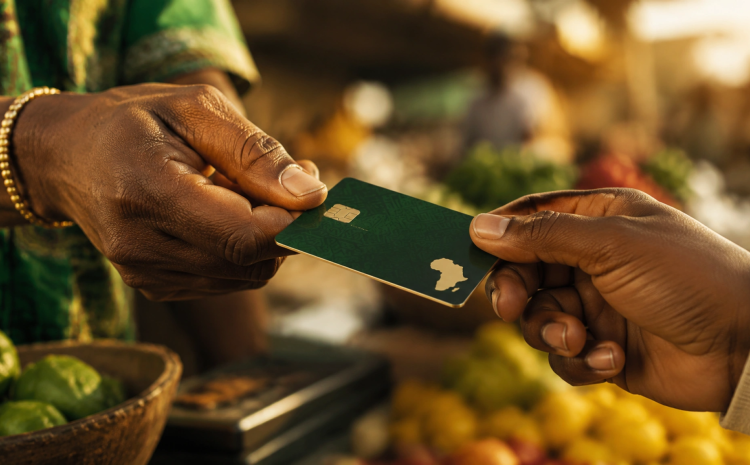
In June 2025, at the Afreximbank annual meetings in that same city, Africa launched PAPSSCARD, the continent’s first pan-African card scheme.
A joint venture between Afreximbank, the Pan-African Payment and Settlement System and Mercury Payment Services, it clears transactions entirely within Africa, settles in local currencies, and keeps the value, the data and the fees onshore. It was built for one explicit purpose:
To route around Visa and Mastercard.
It runs on PAPSS, live since 2022, where central banks settle cross-border payments in local currency. In February 2026, Kenya’s Pesalink network plugged in, linking more than 80 Kenyan participants to more than 160 banks across the continent.
The infrastructure is here. The card is here. What is missing is everything that turns a rail into a habit.
The Entrepreneur Opportunity Lens.
Who wins?
The national switches and issuing banks wiring into PAPSS, Rswitch, Pesalink, Bank of Kigali, who become the on-ramps.
The merchant-acquirer who gets a pan-African card accepted at the till.
The stablecoin builder bridging the gaps the banks are slow to reach, like Daya, which just raised $2.4 million to settle African payments in stablecoins.
The compliance engineer, now that Nigeria’s regulator wants every payment’s data stored onshore by the 1st of January 2027.
Who is squeezed?
Visa and Mastercard, whose intra-African toll was the whole point of the exercise.
The correspondent bank that lived on the double-conversion spread.
The offshore processor holding African transaction data it was never going to hand back.
The gap to build into.
A rail with no acceptance is a road with no cars. PAPSSCARD can settle between currencies; it does not yet sit in every wallet or every POS terminal. The card exists, the issuing, the merchant acceptance, the local-currency liquidity, the stablecoin bridges and the onshore data plumbing do not yet exist at the scale the $1 trillion number says they must.
That is not one company. That is a sector.
None of that gap closes in isolation. The rail-builders, the founders riding it, and the capital that funds the climb each hold one piece of the same answer, and today they work in separate rooms.
Putting them in one is the whole reason the Business Week Afrika Summit exists.
On the 1st and 2nd of October 2026, it convenes as Africa’s hub for the solutionists, the place where a problem like the double-conversion toll stops being something we complain about and becomes the company built to end it.
You earn in naira. You should be able to pay in cedis.
The only question left is who builds the road between them, and whether they will be African.
#TwendeBWA