

Spiro Isn’t Selling Motorcycles. It’s Selling the Energy Network Underneath Them.
What they tell you about electric vehicles:
They are a rich-world story. A Tesla in a California driveway, charging overnight in a two-car garage.
Africa gets there last, once the grids are fixed and the incomes catch up.
What is actually true
A pan-African company just raised $270 million to prove the opposite. Africa is not behind on electric mobility. It is building a version the rich world doesn’t have.
This week Spiro closed its latest round at $270 million, adding $55 million from China’s NewTrails Capital on top of a $215 million raise earlier in June. The money is not for a flashy car. It is for batteries, swap stations and assembly lines.
The whole idea sits in one word.
Swap.
The Western EV depends on the car and the charger: buy the vehicle, buy the long wait, pray the grid holds overnight. Spiro sells none of that.
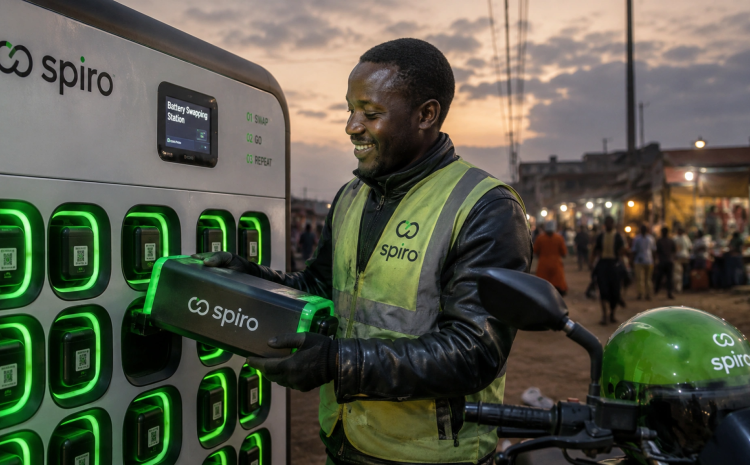
A rider pulls into a station, trades a flat battery for a charged one in the time it takes to buy airtime, and rides off. No downtime. No overnight charging. No upfront battery cost, the most expensive part of the machine.
This is well past a pilot.
Spiro has deployed more than 95,000 electric motorcycles and 2,500 swap stations across 7 markets, Uganda, Kenya, Nigeria, Rwanda, Togo, Cameroon and Benin, completing over 30 million battery swaps across more than 1 billion kilometers of travel.
“Spiro has firmly moved past the proof-of-concept phase.”
Gagan Gupta, Equitane
And the part most people miss is what that money is actually buying.
Spiro isn’t selling electric motorcycles.
It is selling the energy network underneath them.
Because the vehicle that moves Africa was never the sedan. It is the boda boda, the okada, the motorcycle taxi, the continent’s real transport system and, for millions of riders, its income.
Electrify the car and you reach the few. Electrify the boda and you reach the engine of the informal economy itself.
The Entrepreneur Opportunity Lens.
Who wins?
The rider, whose single biggest cost is fuel, and for whom a swap that undercuts petrol is a raise.
The swap-station operator, running an energy retail point on a busy route.
The local assembler, now that the capital is going explicitly into industrial and assembly lines on the continent.
The financier who funds the batteries, the stations and the bikes, the asset layer beneath all three.
Who is squeezed?
The fuel importer and the petrol station on the boda route, whose demand was never loyal, only captive.
The importer of combustion motorcycles, selling a machine that now costs more to run than its electric rival.
The gap to build into.
A swap network is only as good as its density. Spiro runs 2,500 stations; the continent’s boda fleets number in the tens of millions.
Every gap between stations, every market Spiro hasn’t entered, every battery that still needs financing is a company waiting to be built: the station franchise, the battery-as-a-service lender, the local parts maker, the fleet-electrification service.
This is the instinct we keep meeting: don’t import the finished thing, build the system underneath it. We saw it with devices put on a Sh20-a-day plan, and with payment rails settling straight in local currency. Here it is again, wearing a battery.
None of this scales from one company. The energy-network builders, the assemblers, the boda financiers and the riders turning a swap into a living are all solving the same problem from different corners.
Putting them in one room is what the Business Week Afrika Summit is for. On the 1st and 2nd of October 2026, it convenes as Africa’s hub for the solutionists, the place where “Africa will adopt this last” becomes “Africa built this first.”
Africa won’t import the electric age.
It will swap its way into it.
#TwendeBWA