

The Half Empty Factory: Why Africa’s Biggest Health Gap Is a Business Case
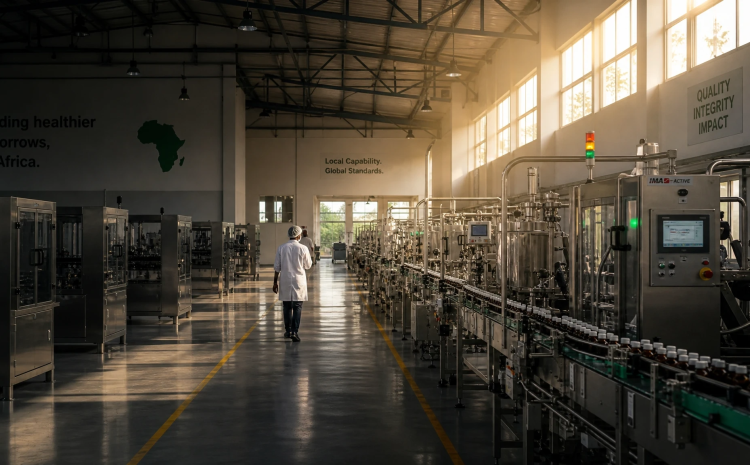
Kenya’s health system needs 1,096 medicine formulations to run.
Its factories make 220 of them.
The other 876 are written on a prescription the country cannot fill at home. They are couriered in from Mumbai and Shenzhen, paid for in hard currency, and waited on while patients wait too. This is not a story about a shortage of pills. It is a story about a shortage of the capacity to make them, sitting in plain sight next to factories running at 40% to 60% of what they could.
The puzzle is why the factories stay half empty. The answer is the most useful thing a builder can read this year.
The economics push manufacturers toward the easy molecule
15 Kenyan manufacturers make paracetamol. The same simple tablet, fifteen times over, because the unit economics of anything harder do not close.
A sterile injectable line costs Sh800 million to stand up, plus another 40% in the costs around it. When a manufacturer does brave the public market, the government takes up to 18 months to pay. No business survives lending its working capital to a customer for a year and a half, so manufacturers quietly route only a quarter of their output to the public system and chase private buyers and export orders instead.
The medicine the public most “needs” is the medicine least profitable to make.
Underneath all of it sits the deepest gap.
Kenya has zero companies producing active pharmaceutical ingredients, the chemical heart of any drug, and exactly one doing the research. So even a “local” tablet is mostly an imported one, formulated and boxed here. Across the continent the picture is the same: Africa imports more than 95% of its active ingredients, and over 70% of its finished medicines.
This is import substitution, applied to the one shelf no country wants to be caught short on.
Who wins, who gets squeezed, and the gap in between
Who is squeezed: the importer’s margin. Every formulation that moves onshore is a shipment that stops leaving the continent in dollars. The fifteenth paracetamol maker, trapped in a commodity with no pricing power, is squeezed too.
Who wins: the builder who climbs one step up the value chain. The 876 unmade formulations are 876 product lines with proven, recurring, non discretionary demand. People do not stop needing medicine in a downturn.
The gap to build into is not one business, it is four. There is the active ingredient itself, the hardest and most defensible rung. There is sterile and specialty manufacturing, where the Sh800 million wall keeps competition thin. There is the financing layer, a vehicle that factors those 18 month government receivables so a manufacturer can make public medicine without bleeding to death waiting to be paid. And there is the boring, bankable middle of the 876: the specialty generics nobody is bothering to formulate because everyone is busy making the fifteenth paracetamol.
The reframe is simple. Africa is not a market that consumes medicine. It is a market that could make it, and currently chooses to write the cheque abroad instead.
The number that turns a health gap into a business case
That cheque is enormous. Africa’s pharmaceutical market is on track to pass $100 billion by 2030. Today the continent makes a minority of it and imports the rest, sending the margin, the jobs, and the resilience to factories in Asia. The instinct is the one BWA keeps returning to: stop exporting the value of the next step, and own it. Cocoa taught it. Minerals taught it. The medicine cabinet is teaching it now, with the highest stakes of all, because this is the value chain where a stockout is not a lost sale, it is a life.
A buildable gap, a $100 billion market, and a problem no government on the continent can afford to ignore. That is not a coincidence of headlines. It is exactly the room the Business Week Afrika Summit exists to convene.
When the continent’s manufacturers, financiers, and health regulators gather on the 1st and 2nd of October 2026, the prescription on the table is the same one Kenya cannot fill today. The Summit is where the people who can fill it find each other: the operator who knows how to stand up an active ingredient plant, the financier who can underwrite an 18 month receivable, the regulator who can fast track a local line. The gap is mapped. The room is being set.
Africa already writes the prescription.
It is time it learned to fill it.