

The Fuel Shock Pivot: Why Africa’s SMEs are Racing Toward the Circular Economy

As Brent crude prices surged toward $120 a barrel in late March 2026, the ripple effects hit Africa’s 44 million SMEs with brutal precision. For many small businesses, transport and energy costs now account for over 50% of total operating expenses.
However, a “Green Pivot” is emerging. Instead of waiting for fuel subsidies, a new wave of African entrepreneurs is leveraging Circular Economy models and Climate Finance to decouple their growth from volatile fossil fuels.
1. The $1.1 Trillion Green Opportunity
As of April 2026, Africa’s green economy is valued at a staggering $1.14 trillion—representing over 40% of the continent’s total GDP. This isn’t just about large-scale wind farms; it is being driven by SMEs in sustainable agriculture, e-mobility, and waste-to-value manufacturing.
The real news for SMEs is the accessibility of capital. This week, KCB Bank Kenya secured Sh12.5 billion ($95M) specifically for green financing targeted at MSMEs and small-scale farmers. This “blended finance” approach—combining grants with low-interest loans—is designed to help small businesses install solar power and transition to electric delivery fleets.
2. Automation Meets the Circular Economy
The “Circular Economy”—where waste is treated as a raw material—is moving from a concept to a high-tech reality.
Just days ago, Kenya unveiled the “TrashBot,” the world’s first fully automated waste segregation solution. Developed through a partnership between local enterprise TakaTaka Ni Mali and international tech firms, this AI-driven system allows counties and SMEs to process mixed waste into organic compost and construction boards.
For the African SME, “Waste management” is no longer a cost; it is a secondary revenue stream.
3. The “Climate-Smart” Competitive Edge
In a market where margins are being squeezed by inflation, “Climate-Smart” SMEs are winning for three reasons:
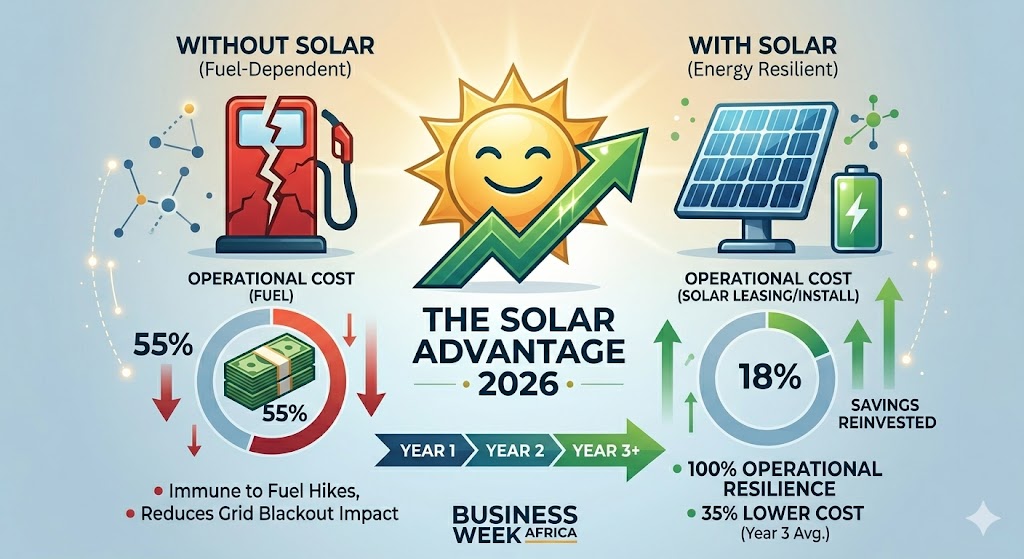
- Operational Resilience: Solar-powered businesses are immune to national grid blackouts and fuel price hikes.
- Supply Chain Integration: Large multinationals are increasingly only sourcing from SMEs that can prove their “Green Credentials” (ESG compliance).
- Access to New Markets: Under the AfCFTA’s 2026 protocols, “Green Certified” goods are receiving priority processing in several regional trade corridors.
The Bottom Line: Efficiency is the New Innovation
In 2026, the most innovative thing an African SME can do is become efficient. Whether it’s adopting AI to reduce waste or using “asset-light” solar leasing, the goal is to build a business that can thrive regardless of global oil prices.
As the International Finance Corporation (IFC) recently noted, the “Trade Finance Gap” is widening for fossil-fuel-dependent firms, but it is shrinking for those that embrace the green transition.