

Nigeria and Kenya Just Built the Machine That Feeds the Agricultural Machine
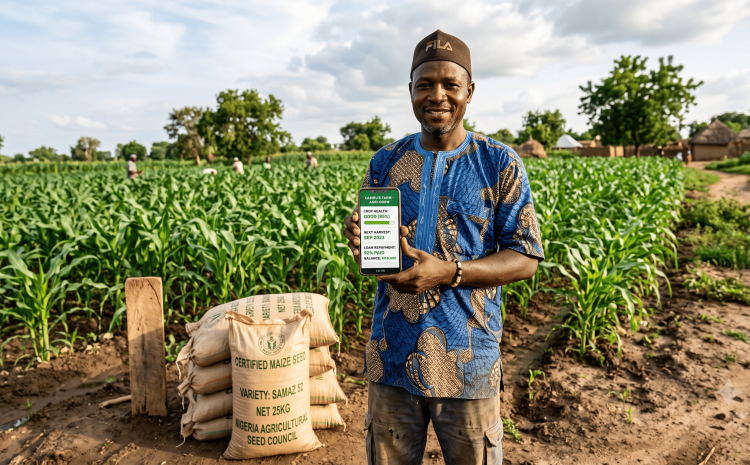
Nigeria grows 11 million tonnes of grain a year. It needs more than double that. This week, without waiting for the gap to close itself, 2 governments built 3 different machines to close it at once: one to lend the money, one to watch the crop, one to bring back the water.
You have heard the missing middle described before. The farm is not the building site, the financing under it is. This week the building site got 3 layers at once.
The money layer
Nigeria’s Bank of Agriculture launched the Renewed Hope Smallholder Agricultural Financing Programme in Zaria, Kaduna State, aimed straight at the 11 to 25 million tonne gap.
A single digit, 9%, credit facility that puts subsidized fertiliser and certified hybrid seed into a farmer’s hands and expects a farm’s revenue to pay it back.
500,000 farmers this season. 2 million next year. 5 million as the long run target. The BOA did not try to reach them all directly. It selected 20 farm aggregators from more than 1,240 applicants, businesses whose entire job is standing between a bank and a smallholder who has never held a loan. That selection process is itself the opportunity. Every aggregator not chosen from that pool of 1,240 is a founder who has already built the muscle this scheme needs and has nowhere yet to deploy it.
You are watching a state build a credit rail and subcontract its last mile to whoever can prove they can walk it.
The intelligence layer
Days later, Nigeria’s Presidential Food Systems Coordinating Unit signed a different kind of infrastructure into being: NAPS, the National Agro Productivity System, a satellite and AI platform that reads farmland from orbit. It identifies a parcel, names the crop growing on it, tracks its growth stage, and refreshes the picture every 5 days, no field agent required.
The technology is not homegrown. It is licensed from Morocco’s OCP Africa and built with Ground Truth Analytics, a geospatial firm, using a model already proven at 90 to 95% accuracy forecasting Morocco’s wheat harvest. The pilot has already reached 250,000 Nigerian farmers, surveyed more than 50,000 producers across 2,000 communities, and logged over 1 million data points across 5 commodities before wider rollout across 15 states.
This is the pattern you have seen before in other sectors, dressed in new clothes. A government cannot build satellite intelligence in house, so it buys the model from a country that already proved it, then hands the operating contract to a private geospatial builder.
Every African government still guessing at its own harvest is a customer for a business that has not been built yet.
The water layer
In Homa Bay, Kenya, a scheme built decades ago and left to silt over just produced its first harvest since revival. The Kimira and Oluch irrigation blocks, 1,474 hectares between them, backed by the Lake Basin Development Authority and the African Development Bank, brought 200 acres back into rice under a gravity fed canal system that needs no diesel pump and no electricity bill.
800 tonnes of Oriang rice, purchased by the government itself, off a scheme with room for 9,000 hectares total. 1,500 smallholders are already growing on it. 3,000 households are the near term target. 400,000 people in the wider Nyanza region sit inside its reach.
The rehabilitation was the hard, unglamorous part: reclaiming more than 2,000 acres of swamp, rebuilding canals nobody had maintained in years. What comes next, moving 809 cultivated hectares toward the full 9,000, is a longer runway than any single harvest, and someone is going to own the logistics, storage and milling layer that catches that rice once the water problem stops being the bottleneck.
The synthesis
2 governments, 1 week.
Nigeria lent the money. Nigeria bought the eyes in the sky. Kenya brought the water back.
None of the these is glamorous on its own. Together they are the missing middle finally getting built out in the open, in public view, with contracts a founder can read.
You do not need to wait for the whole gap to close before you find your layer in it. The aggregator model still has room below the 20 BOA picked. The geospatial contract Nigeria just signed with a Moroccan firm is a template every other food ministry on the continent will eventually need built locally. And 8,191 hectares of Kimira Oluch are still waiting for the businesses that will move, store and mill what comes off them.
This is exactly the kind of building the Business Week Afrika Summit exists to surface, the founders wiring credit, data and water into one working system before the headlines catch up to them. On October 1 and 2, 2026, that is who fills the room.
Secure your seat and meet the builders closing Africa’s missing middle: https://apps.little.africa/events/105
The gap between 11 million tonnes and 25 million was never going to close itself. It is closing because three separate builders decided it would, in the same week, without asking each other’s permission.